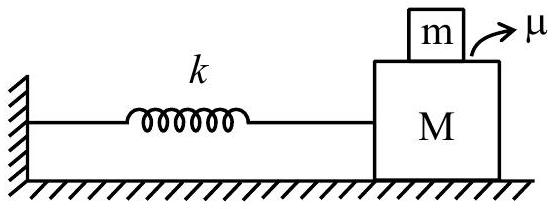
Two blocks of masses m and M,(M>m), are placed on a frictionless table as shown in figure. A massless spring with spring constant k is attached with the lower block. If the system is slightly displaced and released then ( μ= coefficient of friction between the two blocks)
(A) The time period of small oscillation of the two blocks is T=2πk(m+M) (B) The acceleration of the blocks is a=M+mkx ( x= displacement of the blocks from the mean position) (C) The magnitude of the frictional force on the upper block is M+mmμ∣x∣ (D) The maximum amplitude of the upper block, if it does not slip, is kμ(M+m)g (E) Maximum frictional force can be μ(M+m)g.
Choose the correct answer from the options given below :
(A)A, B, D Only✓ Correct
(B)B, C, D Only
(C)C, D, E Only
(D)A, B, C Only
Answer: (A)
Solution
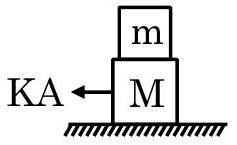
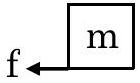
While the two blocks move together the oscillating mass is M+m, so the period is T=2πkM+m and statement (A) holds. The spring force kx accelerates the whole system, so the common acceleration has magnitude a=M+mkx and statement (B) holds. Friction on the upper block must supply exactly its share of this acceleration, f=ma=M+mmkx; the expression in (C) carries a spurious factor μ and is wrong. The block does not slip as long as this required friction stays within the limit μmg; setting M+mmkA=μmg gives the largest amplitude A=kμ(M+m)g, so statement (D) holds. The greatest friction available between the blocks is μmg, fixed by the normal force mg of the upper block, not μ(M+m)g, so (E) is wrong. The correct statements are A, B and D.
JEE Main · 2025 · 03 Apr 2025 · Shift 1 · Single correct option