Of the three science-research routes open to a Class XII student — IISc, the IISERs, and NISER — the last is the least talked about in Delhi-NCR, and arguably the easiest to plan for. NISER runs under the Department of Atomic Energy, its five-year integrated MSc is well regarded, and its entrance exam, the NEST, has one rule that makes it noticeably kinder to a PCM student than the IAT.
Here is what parents and students need to know, in short.
Please note: the figures below are from the official NEST 2026 brochure and are given so that you know the shape of the process. Seat numbers, dates, fees and rules are revised every year — do check nestexam.in and the current brochure before relying on anything here.
What NEST gets you into
NEST is the entrance test for two institutes:
- NISER Bhubaneswar — the National Institute of Science Education and Research, under the Department of Atomic Energy — 200 seats
- UM-DAE CEBS, Mumbai — the Centre for Excellence in Basic Sciences, on the University of Mumbai campus — 57 seats
Both offer a five-year Integrated MSc in Biology, Chemistry, Mathematics or Physics. The test is compulsory for both; there is no other way in.
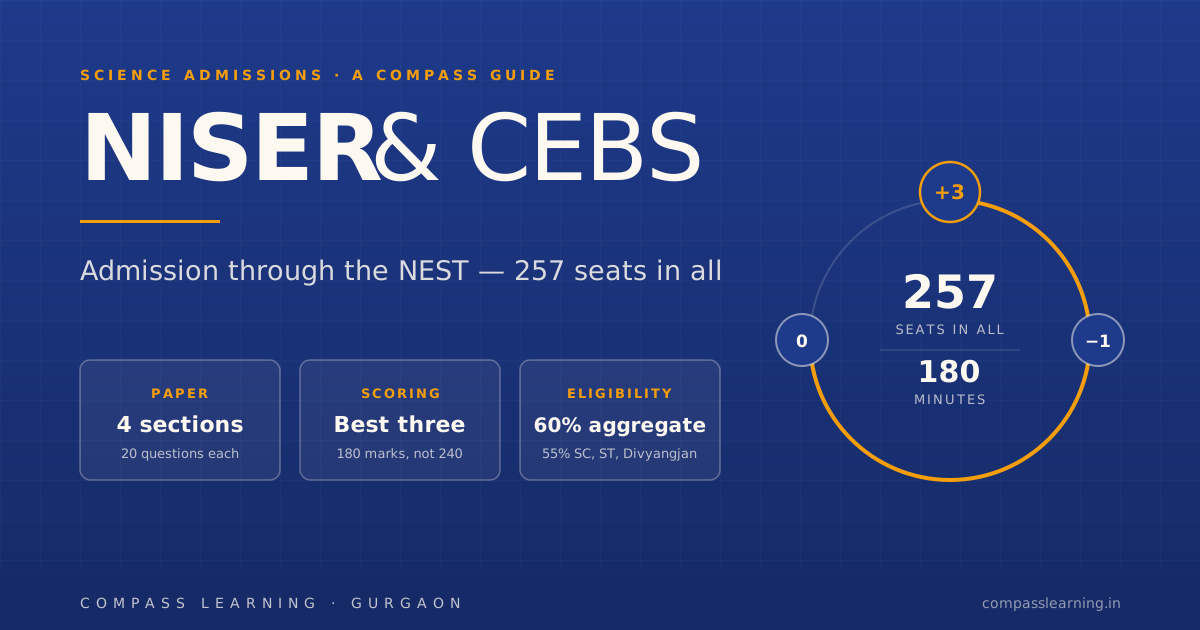
Two hundred and fifty-seven seats in all, which makes this a small and competitive programme — but it also means small classes, early laboratory access, and teaching by working scientists. NISER students regularly go on to doctoral programmes in India and abroad, and the DAE connection brings research opportunities at national laboratories that few undergraduate programmes can offer.
The exam, and the rule that matters
The paper. A computer-based test of three hours, available in Hindi and English. There are four sections — Biology, Chemistry, Mathematics and Physics — with 20 questions each, carrying 60 marks per section. Each correct answer earns 3 marks and each wrong answer loses 1.
The best-of-three rule. This is the part worth reading twice. A candidate must clear a section-wise minimum in at least three sections, and the final score is the total of the best three sections — 180 marks, not 240.
For a PCM student, that is a real advantage over the IAT, where every section counts. A student who has never studied Biology can attempt Physics, Chemistry and Mathematics, clear the minimum in those three, and compete on equal footing. Do note that there is also a Minimum Admissible Percentile, announced with the results, which a candidate must meet to appear in the merit list.
Eligibility. A candidate must have studied at least three of the four subjects — Biology, Chemistry, Mathematics, Physics — in Classes XI and XII. Class XII must have been passed in 2024 or 2025, or be in progress in 2026. The minimum aggregate is 60% (55% for SC, ST and Divyangjan candidates), and the marksheet must come from a single board. There is no age limit.
The calendar. In 2026, applications opened on 5 January and closed on 6 April, admit cards came on 15 May, and the exam was held on 6 June, 2 pm to 5 pm. The fee was ₹1,400 for general and OBC male candidates and ₹700 for reserved-category candidates and for all female candidates.
Note the date carefully: NEST and the IAT usually fall within a day or two of each other in early June. Writing both is entirely practical — the syllabus is the same — but the two application windows are different, and the NEST window opens in January, much earlier than most students expect.
What to prepare
The brochure is explicit: the syllabus follows the CBSE Class XI and XII curriculum and the NCERT textbooks, with some Class X material assumed. There is no separate syllabus to chase.
Physics covers mechanics, thermodynamics, electricity and magnetism, optics, modern physics and semiconductors. Chemistry covers the usual physical, inorganic and organic ground, including biomolecules. Mathematics runs from sets and functions through calculus, matrices, vectors, three-dimensional geometry and probability.
In other words, a student preparing properly for the boards and for JEE is already most of the way there. What the NEST asks for in addition is accuracy under a clock, across short questions, with a penalty for guessing — which is a matter of practice, not of new content.
How to decide between the three
If your child is drawn to science rather than engineering, the sensible approach is not to choose one of these but to write more than one. They share a syllabus, they fall within a few weeks of each other, and each one that goes well adds an option.
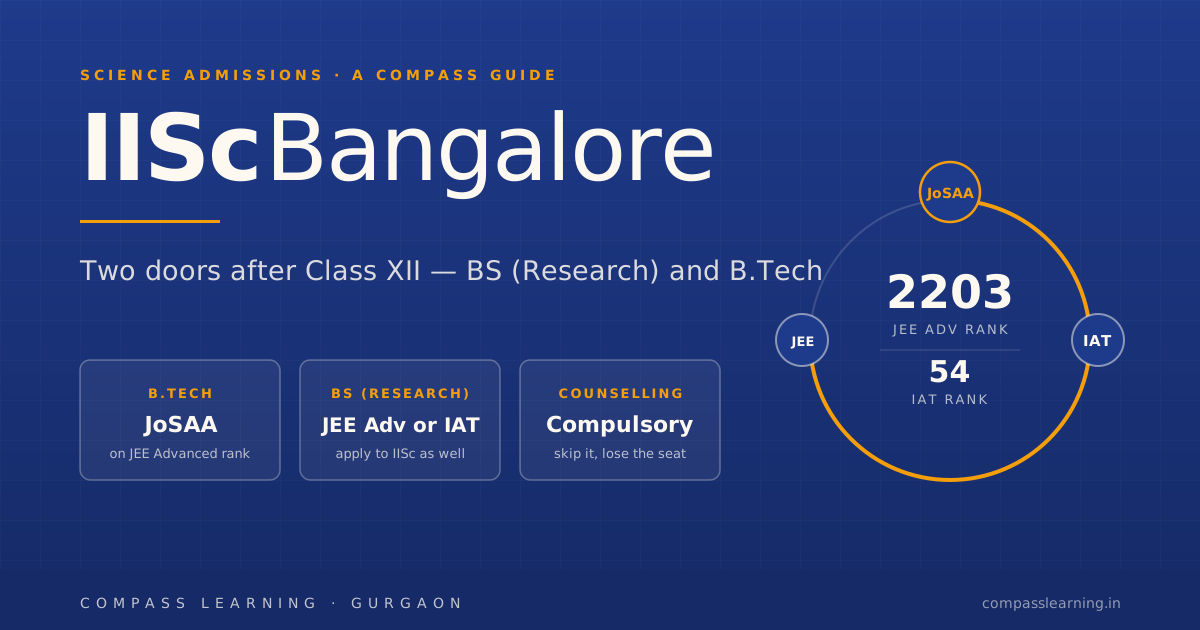
- IISc Bangalore — the most selective, reached through JEE Advanced or the IAT
- The IISERs, through the IAT — seven institutes, about 2,300 seats, and a score that several IITs and IISc also accept
- NISER and CEBS, through the NEST — smaller, DAE-backed, and the friendliest of the three to a student without Biology
The one thing we would urge is to decide early. A student who knows in Class XI that research interests him will prepare with a calmer mind and a better plan than one who discovers these exams in April of Class XII. If you would like to think it through with someone, do talk to us — we teach the same Class XI-XII Physics, Chemistry and Mathematics that all three of these exams are built on.