Chandigarh University: A Profile of CU Gharuan for Engineering Aspirants
A newer institute that's grown rapidly and aggressively
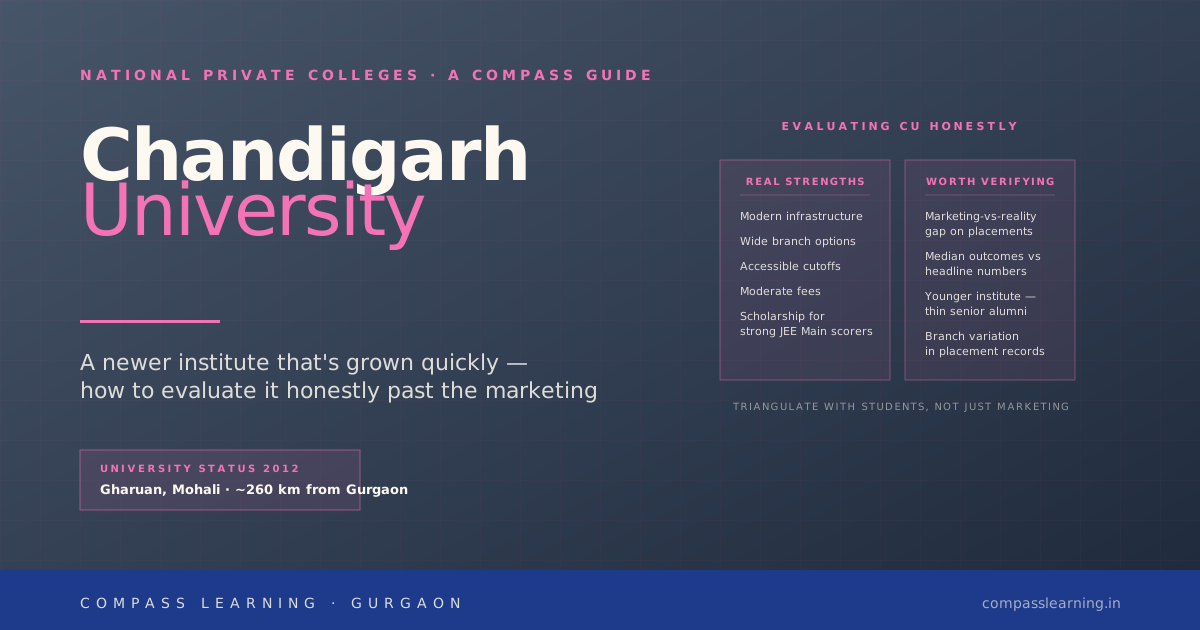
Chandigarh University (CU) was founded in 2012 — making it about a decade old as a chartered university. It sits at Gharuan in Mohali district, about 25 km from Chandigarh city and roughly 260 km from Gurgaon. The institute has grown remarkably quickly in its first decade, expanding its programs, intake, infrastructure, and marketing footprint at a pace that few Indian engineering universities have matched.
For Gurgaon families considering options, CU appears frequently in advertising and on social media — visible enough that many students know the name even before researching engineering colleges in detail. The visibility itself isn't proof of quality, and several considerations matter when evaluating CU honestly. This article walks through what CU is, how admissions work, what the academic and placement track record looks like so far, and how to think about whether it fits.
Note: This article is written to be evergreen, but specific dates, fees, eligibility thresholds, and cutoff numbers are set each year by the institute. Always cross-check the latest official notifications before acting on anything time-sensitive.
About the university
A few structural features:
- Founded 2012 as Chandigarh University, after operating earlier as Chandigarh Engineering College
- Located at Gharuan, Mohali district, Punjab — adjacent to but not within Chandigarh city
- Private, multi-disciplinary university — engineering is one of many schools alongside management, law, pharmacy, hospitality, animation, journalism, and others
- Large and growing scale — total student intake across all programs is in the tens of thousands
- Highly visible marketing — CU has been notable for its aggressive marketing presence across social media, education portals, and traditional media
The growth trajectory has been rapid, and the institute markets itself prominently. For students and families considering CU, separating the marketing narrative from the on-ground reality is worth careful attention.
How admissions work
- Entrance exams accepted: CUCET (CU's own entrance test), JEE Main, or direct admission for high board scorers
- Class XII boards: Minimum percentages vary by program (typically 50-60%+ for general)
- Counselling: CU runs its own admission process
CU's admission bar is notably softer than the more selective national private institutes. The entrance is accessible to a wide range of academic profiles, which is part of what enables the institute's large scale.
Branches and programs
CU offers BTech across many branches, often with specialisations:
- Computer Science and Engineering (CSE) — with many specialisations (AI/ML, Cybersecurity, Cloud, Data Science, IoT, Gaming, Blockchain, Mobile Apps, and several more)
- Computer Science and Business Systems (in some collaborations with industry partners like TCS)
- Information Technology
- Electronics and Communication Engineering
- Electrical Engineering
- Mechanical Engineering
- Civil Engineering
- Biotechnology
- Aerospace Engineering
- Mining Engineering
- Petroleum Engineering
The branch and specialisation breadth is unusually wide. As at Bennett and VIT, many of the named "specialisations" are CSE programs with focused elective sequences rather than fundamentally different curricula.
Cutoffs and competitiveness
CUCET-based entry is moderate in selectivity:
- CSE / IT and specialisations: typically accessible to students in the JEE Main 60-80 percentile range, or comparable CUCET scores
- Other engineering branches: more accessible
- Direct admission via board scores: available to students with strong Class XII performance
This makes CU significantly less selective than DTU/NSUT/IIIT Delhi (all of which require JEE Main 95+ percentile for CS) and also less selective than VIT, Manipal, and Thapar.
Campus, hostel, and student life
The Gharuan campus is large and visually impressive:
- Hostels: On-campus accommodation for outstation students; multiple hostel blocks
- Academic infrastructure: Modern academic blocks, labs, sports facilities
- Sports: Cricket and football grounds, courts, indoor sports
- Clubs and societies: Wide range across disciplines
- Annual fests: Cultural and technical events, often featuring well-known performers
The campus is one of CU's most visible marketing assets. Infrastructure is modern, well-maintained, and substantial in scale. The visual presentation is on the institutional-modern end.
Placements
CU publishes placement statistics that have been the subject of some discussion in the higher education community. Honest reading of placement data here requires care.
What CU publishes:
- High headline numbers for "highest packages" — sometimes ₹50+ LPA or higher figures highlighted in marketing
- Average and median packages quoted for top branches
What's worth understanding:
- Headline numbers vs typical outcomes: As at most universities, the "highest package" reflects a small number of exceptional offers. The typical (median) outcome is meaningfully lower.
- Recruiter mix: A significant portion of placements are with IT services companies (TCS, Wipro, Cognizant, Infosys), training-and-placement combined contracts, and similar entry-level roles. Product company placements exist but are less central.
- Variation by branch: As at most institutes, CSE and CSE-specialisation branches outperform core engineering branches. The variation is significant.
A realistic expectation for a typical CU CSE graduate's first job: ₹5-8 LPA range, with the top quartile reaching meaningfully higher and the bottom quartile lower. The "average" figure CU publishes should be understood in this context.
Fees and financial aid
CU's fee structure is in the moderate range for private universities:
- Tuition + academic charges: ~₹2-3 lakh per year (varies by program and specialisation)
- Hostel + mess: additional ~₹1-1.5 lakh per year
- Four-year total: typically ₹14-20 lakh including hostel
Lower than BITS, MIT Manipal, Shiv Nadar, or Ashoka. Comparable to VIT.
Scholarships are available based on JEE Main scores, board performance, and CUCET ranks. Strong scorers can receive substantial fee waivers, sometimes covering 50%+ of tuition.
For Gurgaon students specifically
CU Gharuan is approximately 260 km from Gurgaon — comparable to Thapar Patiala in distance:
Travel:
- By road: ~4-5 hours via NH-44 through Karnal/Ambala. Reasonable for visits.
- By train: Trains from Delhi to Chandigarh (~3-4 hours), then road to campus
- By air: Chandigarh airport is closest, but for Gurgaon families road transit is typically more practical
Practical proximity: Among the options in Wave 3C, CU is one of the more accessible from Gurgaon — second-closest to Thapar Patiala.
Network in Gurgaon: CU's alumni base is younger (institute is only ~12 years old as a university), so the alumni footprint at senior levels is still building. The network is present but less dense than at established institutes.
What to know before committing
A few items worth weighing honestly:
- The marketing-vs-reality gap is worth being attentive to. CU is genuinely visible in advertising and PR. Some of the claims used in marketing (top packages, ranking achievements, specific recruiter visits) are real but represent the upper distribution rather than typical outcomes. Triangulate by speaking with current students or recent graduates, not just relying on marketing materials.
- The branch and specialisation breadth includes some recently added options. Some of the more specialised branches (Gaming, Blockchain, etc.) are recent additions; track records for student outcomes in these are limited.
- The size and growth pace shape the experience. A rapidly growing institute means infrastructure, faculty, and processes are continuously expanding. This can mean modern facilities but also organisational pressure points as scale increases.
- For families considering CU primarily based on marketing exposure: make sure you've also evaluated DTU, NSUT, IIIT Delhi, Thapar, and similar institutes that may not advertise as visibly but have stronger placement track records for top branches.
Rankings published by various agencies place CU in different positions depending on the methodology used. Some rankings have shown the institute in higher positions than its admissions selectivity or placement record might suggest — this is a context worth being aware of when reading ranking-based marketing.
Is CU the right fit?
CU is a reasonable fit if:
- Your JEE Main rank or board scores don't reach the more selective national private options (BITS, top branches at VIT/Manipal/Thapar) but you want a private university option
- You qualify for substantial scholarship/fee waiver based on academic performance
- You value modern campus infrastructure and a contemporary university feel
- You are comfortable with a younger institute still building its long-term reputation
- The fee structure is workable for your family
The fit is less clear if:
- You have options at DTU, NSUT, IIIT Delhi, or other more established institutes — these typically offer stronger placement track records
- Your most realistic CU branch is a less-placing one, and you have better options elsewhere
- You are choosing CU primarily based on marketing visibility rather than independent evaluation
- Top-quartile placement outcomes matter substantially to you — the realistic median outcomes at CU are more moderate than headline marketing numbers suggest
For students considering CU CSE alongside, say, Thapar ECE or DTU Mechanical — the right answer depends on what you actually want. Thapar's ECE and DTU's Mechanical have stronger established placement records than CU's CSE in typical outcomes; CU's CSE offers a CS-leaning degree at a more accessible bar. Make the call based on realistic projected outcomes for the specific branch, not on the institute name.
If you're thinking through engineering admissions and want to talk it through, we're at Ardee City, Sector 52, Gurgaon. Drop by anytime — a fifteen-minute conversation is usually enough to start clarifying which direction makes sense for you.
For more on how admissions, counselling, and college choice fit together, see our full Engineering Admissions Roadmap.