VIT Vellore: A Profile of Vellore Institute of Technology and Its Multi-Campus System
A very different scale from the Delhi engineering colleges
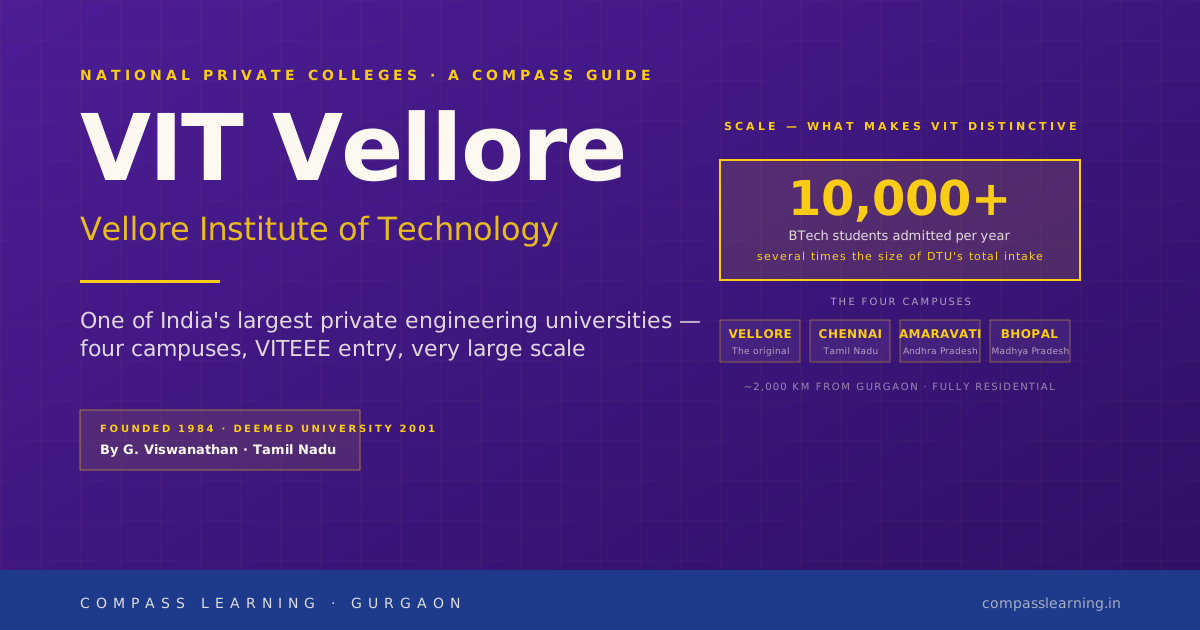
VIT (Vellore Institute of Technology) is one of the largest private engineering universities in India. Across its four campuses — Vellore, Chennai, Amaravati (AP), and Bhopal — it admits over 10,000 BTech students per year. This is several times the size of the entire DTU intake. The scale itself shapes everything about VIT — admissions, branch structure, campus culture, placements, and the kind of education students experience.
For Gurgaon students, VIT is one of the most commonly considered national private options, particularly for those who want a structured BTech experience without the BITSAT-level competitive bar. This article walks through what VIT is, how admissions work, what makes the institute distinctive, and how to think about whether it fits.
Note: This article is written to be evergreen, but specific dates, fees, eligibility thresholds, and cutoff numbers are set each year by the institute. Always cross-check the latest official notifications before acting on anything time-sensitive.
About VIT
A few structural features that shape VIT's character:
- Founded 1984 by G. Viswanathan as Vellore Engineering College; granted deemed-university status in 2001.
- Four campuses: Vellore (Tamil Nadu, the original and largest), Chennai (TN), Amaravati (Andhra Pradesh), and Bhopal (Madhya Pradesh). Vellore is by far the largest and most established.
- Very large scale. Vellore campus alone admits around 5,000 BTech students per year. Total VIT BTech intake across campuses is around 10,000+ per year.
- Wide branch spectrum with many specialisations layered on top of core branches.
- Highly structured academic and disciplinary system — strict attendance, formal class schedules, exam-heavy assessment, residential rules.
The scale is both VIT's defining strength and its defining trade-off. The pros: well-developed infrastructure, broad branch options, large alumni network, organised processes. The cons: variation in quality of experience across such a large cohort, less individual faculty attention, rule-heavy culture.
How admissions work
- Entrance exam: VITEEE (VIT Engineering Entrance Examination), VIT's own admission test
- Class XII boards: PCM aggregate (typically 60%+ for general)
- JEE Main: Not formally required, though JEE Main scores can be used as a supporting factor in some cases. VITEEE is the primary path.
- Counselling: VIT runs its own admission cycle, separate from JoSAA. Counselling is rank-based on VITEEE scores, with branch and campus preferences submitted.
VITEEE is conducted as an online computer-based test. The exam is moderately difficult compared to JEE Main — easier than JEE Advanced but more selective than basic state CETs. Top performers can secure CS at Vellore campus; rank requirements drop for other campuses and branches.
Branches and programs
VIT offers BTech in a wide range, with many specialised sub-branches:
- Computer Science and Engineering (CSE) — multiple specialisations including AI/ML, Cybersecurity, Data Science, IoT, Bioinformatics, Software Engineering
- Information Technology
- Electronics and Communication Engineering (ECE) — also with specialisations
- Electrical and Electronics Engineering
- Electronics and Instrumentation
- Mechanical Engineering with specialisations
- Mechatronics
- Civil Engineering
- Chemical Engineering
- Biotechnology
- Production and Industrial Engineering
The "specialisation" model at VIT, as at Bennett, is partly curricular and partly marketing. A "CSE with AI specialisation" at VIT is largely a CSE program with some AI-focused electives — the core CS content is broadly the same as base CSE.
Cutoffs and competitiveness
VITEEE ranks vary significantly by campus and branch:
- CSE Vellore: typically requires VITEEE rank under ~3,000
- CSE Chennai / Amaravati / Bhopal: typically rank under ~7,000-15,000 depending on campus
- ECE Vellore: typically rank under ~6,000
- Mechanical / Chemical / Civil at Vellore: typically rank under ~15,000-25,000
- Most branches at smaller campuses: more accessible
Because VITEEE is VIT-specific, you can't directly map JEE Main performance to VITEEE rank. Many strong JEE Main scorers don't perform proportionally well on VITEEE if they haven't prepared specifically.
Campus, hostel, and student life
The Vellore campus is large (about 360 acres), well-developed, and intensely residential:
- Hostels: Mandatory for outstation students; on-campus residence is the default
- Academic infrastructure: Modern lecture halls, labs across departments, library, sports facilities
- Sports: Cricket and football grounds, swimming pool, athletics, indoor facilities
- Clubs and societies: Hundreds of student clubs across technical, cultural, social impact, sports, language
- Annual fests: Riviera (cultural) and gravitas (technical) are among the largest college fests in India by attendance
- International student presence: Significant — VIT actively recruits international students, giving the campus more cultural mix than most Indian engineering colleges
The campus culture is notably rule-heavy compared to most Delhi engineering colleges. Attendance requirements are strict, exam schedules are dense, hostel rules are enforced. Students who thrive in structured environments often do well at VIT; students who chafe against rules may find the culture difficult.
Placements
VIT placement statistics are strong overall but with significant variation by branch and individual performance:
- Average package (CSE, Vellore): typically ₹9-13 LPA in recent years
- Median package (CSE): typically ₹7-10 LPA
- Top 10% of CSE placements: ₹20-40 LPA range
- Highest package: ₹1+ crore in top years
- Other branches: typically ₹5-9 LPA average
- Top recruiters: Amazon, Microsoft, Wipro, TCS, Cognizant, Accenture, several product companies and startups
Two things worth understanding about VIT placements:
-
The average is moderate but the upper distribution is strong. A student who performs well at VIT (top quartile of their branch) can match outcomes from much smaller, more selective institutes. A student who coasts will end up with placements that look more like a regular regional engineering college.
-
The IT services tilt is real. A significant portion of VIT placements are at IT services companies (TCS, Infosys, Wipro, Cognizant) rather than product companies. Whether that's good or bad depends on your career goals.
Fees and financial aid
VIT's fee structure is moderate by private-university standards:
- Tuition + academic charges: ~₹2-3 lakh per year (varies by branch and category)
- Hostel + mess: additional ~₹80,000-1.5 lakh per year
- Four-year total: typically ₹14-20 lakh including hostel
This is significantly lower than BITS, Shiv Nadar, or Ashoka, while sitting above DTU/NSUT. For families weighing options, VIT is in the affordable end of private universities.
Scholarships are available based on VITEEE rank — top rankers receive significant fee waivers, sometimes covering full tuition. If you score well on VITEEE, the effective cost can come down meaningfully.
For Gurgaon students specifically
The Vellore campus is approximately 2,000 km from Gurgaon. The other VIT campuses (Chennai, Amaravati, Bhopal) are similarly distant. This is a major distance:
Travel:
- Flight required: Closest airport (Chennai or Bangalore) followed by road transit. Total typical travel time: 6-8 hours door to door.
- Train: Long-distance trains exist but take 30+ hours
- Visits home: Realistically limited to semester breaks for most students
Going far from home: VIT is genuine long-distance education. For first-time-away-from-home students, this is a significant adjustment. For families, regular weekend visits aren't practical.
Network in Gurgaon: VIT alumni are present across Gurgaon's tech industry, especially at IT services companies and many product firms. The alumni network is large but more distributed than DTU/NSUT — there are VIT alumni at most companies but the density at any one company tends to be lower.
What to know before committing
A few things worth weighing:
- The institute's scale shapes everything. With 5,000+ students per year just at Vellore, you are one of many. Faculty attention, peer interactions, hostel allocations, even classroom space all reflect this scale.
- The structured/rule-heavy culture is real. This isn't an opinion — VIT explicitly markets a structured academic and disciplinary environment. Attendance enforcement is strict, hostel curfews exist, mandatory mess timings are real. Some students appreciate the structure; others find it confining.
- Branch and individual performance matter more than at smaller institutes. A CSE rank in the top quartile leads to substantially different outcomes than the bottom quartile of the same branch. The institute "average" can mask wide individual variation.
- The specialisation labels are largely a marketing layer. As at Bennett, choosing "CSE with AI specialisation" vs base CSE doesn't fundamentally change the BTech curriculum — it just adds some elective requirements.
Is VIT the right fit?
VIT is a reasonable fit if:
- Your VITEEE rank gives you a strong CSE or related-CS branch at Vellore campus
- You qualify for substantial fee waivers based on top VITEEE performance
- You thrive in structured academic and residential environments
- You are comfortable being genuinely far from home for four years
- You value the large alumni network and broad placement reach
The fit is less clear if:
- You have stronger alternatives at DTU/NSUT/IIIT Delhi at similar or lower cost
- Your VITEEE rank gives you only a smaller-campus seat in a less-placing branch
- You prefer a smaller, less rule-heavy academic environment
- Distance from home is a meaningful concern for your family
For students choosing between, say, VIT Vellore CSE and DTU Computer Engineering — both are real options. DTU is more affordable, closer to home, and has stronger CS placement averages. VIT offers larger scale, the structured environment, and a broader campus experience. The choice depends on which trade-offs matter most to you.
If you're thinking through engineering admissions and want to talk it through, we're at Ardee City, Sector 52, Gurgaon. Drop by anytime — a fifteen-minute conversation is usually enough to start clarifying which direction makes sense for you.
For more on how admissions, counselling, and college choice fit together, see our full Engineering Admissions Roadmap.