JEE Advanced · 2021 · 03 Oct 2021 · Paper 1 · Haloalkanes and Haloarenes

WhatsApp Email
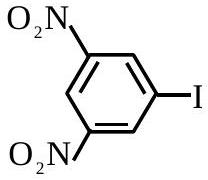
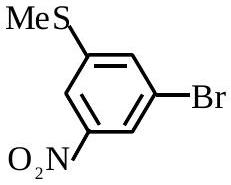
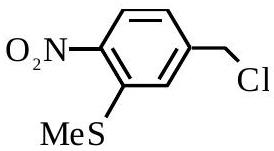
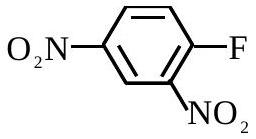
The reaction of with PhSNa yields an organic compound (major product) that gives positive Carius test on treatment with followed by addition of . The correct option(s) for is (are).
  1. (A)(see structure)
    ✓ Correct
  2. (B)(see structure)
  3. (C)(see structure)
  4. (D)(see structure)
    ✓ Correct

Answer: (A), (D)

Solution

PhSNa (sodium thiophenoxide) acts as a nucleophile and undergoes nucleophilic aromatic substitution (SNAr) with activated aromatic halides. The reaction requires strong electron-withdrawing groups (like NO₂) to activate the ring.

The product must contain sulfur to give a positive Carius test (formation of BaSO₄ precipitate after oxidation with Na₂O₂).

Options (A) and (D) both have:
  1. A nitro group (strong electron-withdrawing) to activate the ring
  2. A good leaving group (F in A, Cl in D) at a position suitable for SNAr

The reaction replaces the halogen with -SPh group, and the resulting sulfur-containing compound gives a positive Carius test.

JEE Advanced · 2021 · 03 Oct 2021 · Paper 1 · One or more correct options
More JEE Advanced questions on Haloalkanes and Haloarenes

  1. For the reaction sequence given below, the correct statement(s) is(are)

    (In the options, X is any atom other than carbon and hydrogen, and it is different in P, Q and R)
    JEE Advanced 2025View solution →
  2. In the following reactions, P, Q, R, and S are the major products. …
    JEE Advanced 2023View solution →
  3. Match the reactions in List-I with the features of their products in List-II and choose the correct option.

    List-I
    (P) (-)-1-Bromo-2-ethylpentane (single enantiomer)
    (Q) (-)-2-Bromopentan …
    JEE Advanced 2023View solution →
  4. For the following compounds, the correct statement(s) with respect to nucleophilic substitution reactions is(are)

    (see structure) I

    (see structure) II

    (see structure) III

    (see structure) IV
    JEE Advanced 2017View solution →
  5. in acetone, undergoes reaction with each of and . The rates of the reaction vary as
    JEE Advanced 2013View solution →
  6. The total number of alkenes possible by dehydrobromination of 3-bromo-3-cyclopentylhexane using alcoholic KOH is
    JEE Advanced 2011View solution →