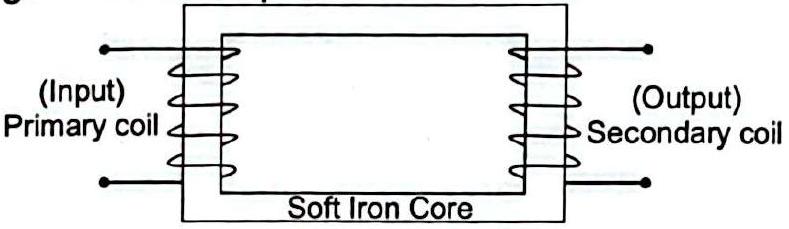
(a) Write the function of a transformer. State its principle of working with the help of a diagram, and mention the various energy losses in this device. (b) The primary coil of an ideal step-up transformer has 100 turns and the transformation ratio is also 100. The input voltage and power are 220V and 1100W respectively. Calculate (i) the number of turns in the secondary, (ii) the current in the primary, (iii) the voltage across the secondary, (iv) the current in the secondary, and (v) the power in the secondary.
Solution
(a) A transformer changes an alternating voltage from one value to another. It works on mutual induction: the alternating flux produced by the primary links the secondary and induces an emf there, with VpVs=NpNs. Energy losses are copper loss (I2R in the windings), iron (eddy-current) loss, hysteresis loss, and flux-leakage loss. (b) Transformation ratio NpNs=100 with Np=100, Vp=220V, Pp=1100W: (i) Ns=100×Np=100×100=10000. (ii) Ip=VpPp=2201100=5A. (iii) Vs=100×Vp=100×220=22000V. (iv) For an ideal transformer Is=100Ip=1005=0.05A. (v) Ps=Pp=1100W.