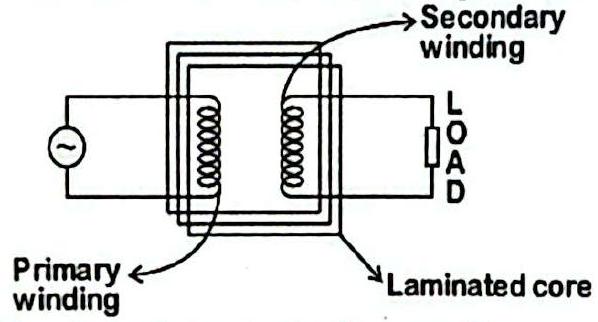
(b)(i) Describe the construction and working of a transformer and hence obtain the relation for VpVs in terms of the number of turns of the primary and secondary. (ii) Discuss four main causes of energy loss in a real transformer.
(i) Construction: two coils — primary (Np turns) and secondary (Ns turns) — are wound on a common laminated soft-iron core. Working: an alternating voltage applied to the primary drives a changing flux ϕ through the core, which links the secondary and induces an emf in it (mutual induction). For an ideal transformer the same flux threads each turn, so
Vp=−Npdtdϕ,Vs=−Nsdtdϕ⇒VpVs=NpNs
(ii) Four causes of energy loss in a real transformer: Copper loss — I2R heating in the primary and secondary windings. Eddy-current loss — circulating currents induced in the core (reduced by lamination). Hysteresis loss — energy spent repeatedly magnetizing and demagnetizing the core. Flux-leakage loss — not all the primary flux links the secondary.