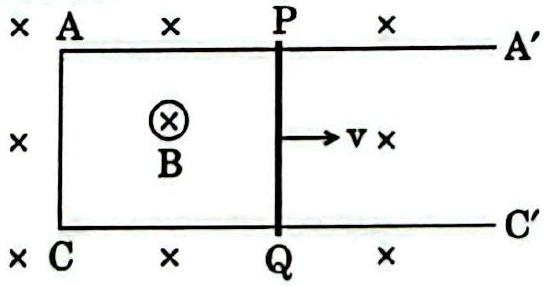
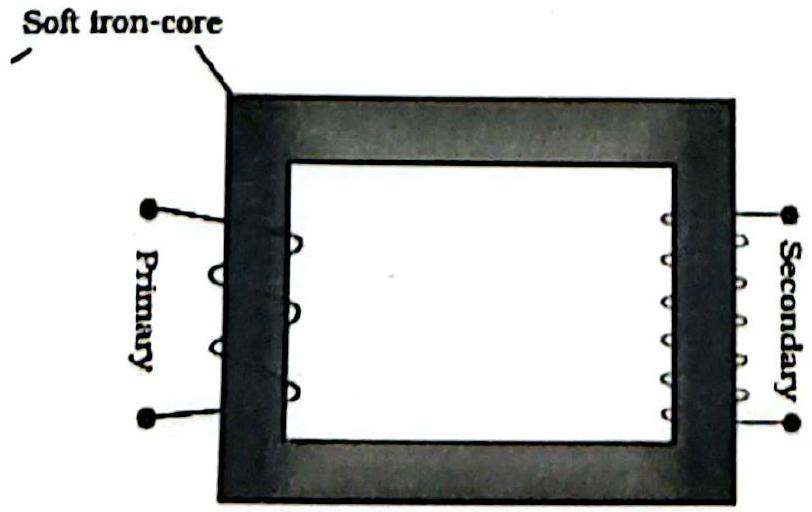
(a) With the help of a labelled diagram, explain the working of a step-up transformer. Give reasons to explain the following: (i) the core of the transformer is laminated, (ii) thick copper wire is used in the windings. (b) A conducting rod PQ of length 20 cm and resistance 0.1Ω rests on two smooth parallel rails of negligible resistance AA' and CC'. It can slide on the rails, and the arrangement is positioned between the poles of a permanent magnet producing a uniform magnetic field B=0.4T. The rails, the rod and the magnetic field are in three mutually perpendicular directions as shown in the figure. If the ends A and C of the rails are short-circuited, find (i) the external force required to move the rod with uniform velocity v=10cm/s, and (ii) the power required to do so.
Solution
(a) A step-up transformer has Ns>Np wound on a common soft-iron core. An alternating primary current produces a changing flux shared by both coils, inducing a larger emf in the secondary: VpVs=NpNs. (i) The core is laminated to break up the paths of eddy currents, reducing eddy-current heating. (ii) Thick copper wire has low resistance, which minimizes the I2R (copper) heat loss in the windings. (b) Here ℓ=0.20 m, R=0.1Ω, B=0.4 T, v=0.10 m s−1. Motional emf: ε=Bℓv=0.4×0.20×0.10=8×10⁻³ V. Induced current: I=Rε=0.18×10−3=8×10⁻² A. (i) To move the rod at constant velocity, the external force balances the magnetic force: