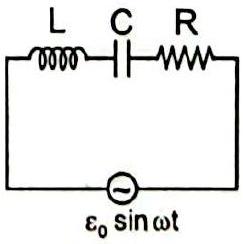
(a)(i) You are given three circuit elements X, Y and Z. They are connected one by one across a given a.c. source. It is found that V and I are in phase for element X, V leads I by 2π for element Y, while I leads V by 2π for element Z. Identify the elements X, Y and Z. (ii) Establish the expression for the impedance of the circuit when elements X, Y and Z are connected in series to an a.c. source. Show the variation of current in the circuit with the frequency of the applied a.c. source. (iii) In a series LCR circuit, obtain the conditions under which (1) the impedance is minimum and (2) a wattless current flows in the circuit.
Solution
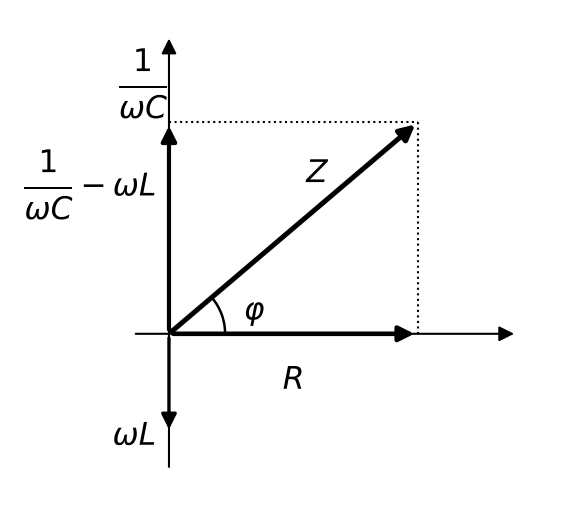
(i) For X, V and I are in phase → X is a resistor. For Y, V leads I by 2π → Y is an inductor. For Z, I leads V by 2π → Z is a capacitor. (ii) In series the same current flows; VR=IR (in phase), VL=IXL (leads) and VC=IXC (lags). The net source voltage is V=VR2+(VL−VC)2=IZ, so
Z=R2+(ωL−ωC1)2
The current I=ZV is maximum at the resonant frequency fr=2πLC1 and falls off on either side, giving a sharp peak in the I–f curve. (iii) (1) Impedance is minimum, Z=R, when XL=XC, i.e. at resonance ω=LC1 — then current and voltage are in phase. (2) A wattless current flows when R=0 (purely reactive circuit), so ϕ=2π and Pav=VrmsIrmscos2π=0.