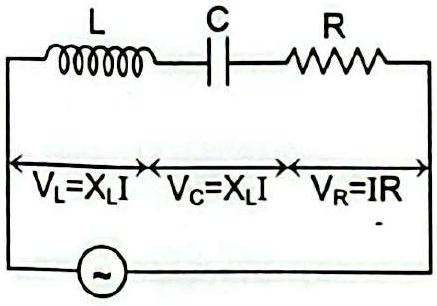
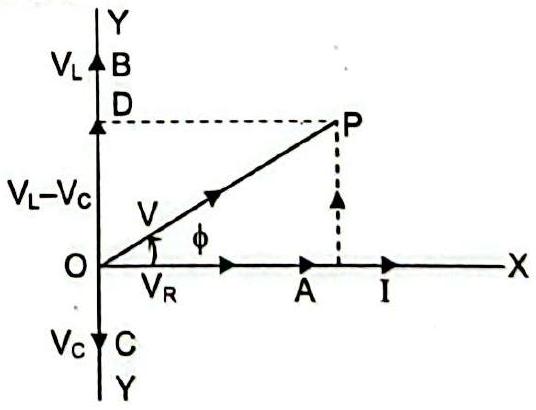
(a) An AC source of voltage V=V0sinωt is connected to a series combination of L, C and R. Use a phasor diagram to obtain expressions for the impedance of the circuit and the phase angle between the voltage and the current. Find the condition for the current to be in phase with the voltage, and state what the circuit is then called. (b) In a series LR circuit XL=R and the power factor of the circuit is P1. When a capacitor with capacitance C such that XL=XC is put in series, the power factor becomes P2. Calculate P1/P2.
Solution
(a) In the phasor diagram VR=IR is along the current, VL=IXL leads by 90∘ and VC=IXC lags by 90∘. The resultant source voltage is
V=VR2+(VL−VC)2=IR2+(XL−XC)2
so the impedance is
Z=R2+(XL−XC)2,tanϕ=RXL−XC
The current is in phase with the voltage when XL=XC, i.e. at resonance; the circuit is then called a series resonant (acceptor) circuit, with Z=R. (b) For the LR circuit with XL=R: Z1=R2+R2=R2, so
P1=cosϕ1=Z1R=R2R=21
Adding C with XC=XL gives resonance, Z2=R, so P2=RR=1. Hence