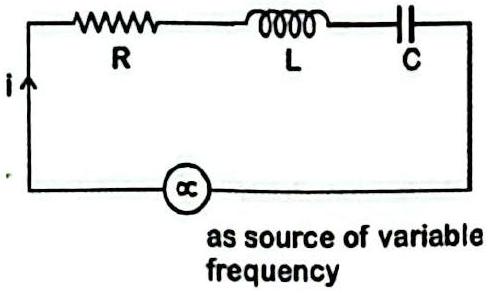
(a) In a series LCR circuit connected across an a.c. source of variable frequency, obtain the expression for its impedance and draw a plot showing its variation with the frequency of the a.c. source. (b) What is the phase difference between the voltages across the inductor and the capacitor at resonance in the LCR circuit? (c) When an inductor is connected to a 200 V d.c. voltage, a current of 1 A flows through it. When the same inductor is connected to a 200 V, 50 Hz a.c. source, only 0.5 A current flows. Explain why, and also calculate the self-inductance of the inductor.
Solution
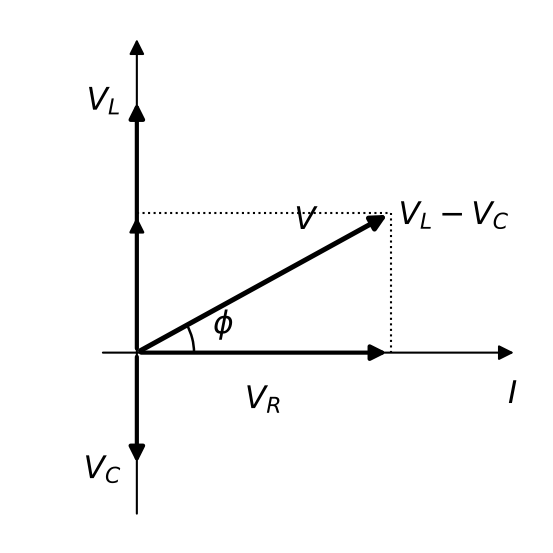
(a) With VR=IR (in phase), VL=IXL (leads by 2π) and VC=IXC (lags by 2π), the source voltage is V=VR2+(VL−VC)2=IR2+(XL−XC)2, so
Z=R2+(ωL−ωC1)2
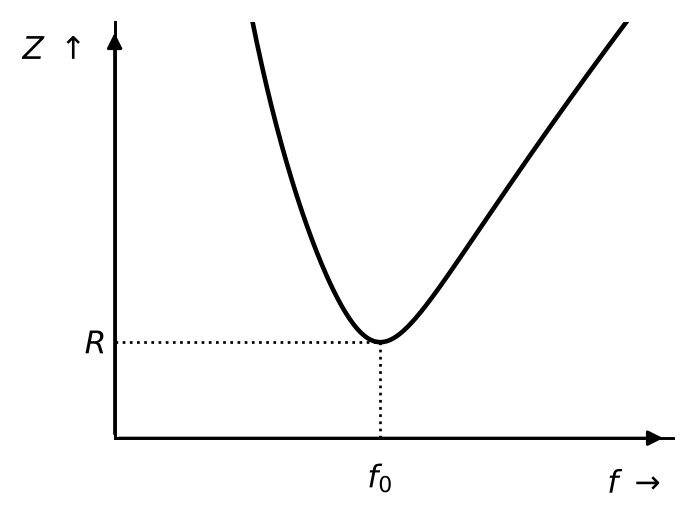
It is large at low and high f, dips to a minimum Z=R at fr=2πLC1, giving a V-shaped curve. (b) At resonance VL leads and VC lags the current each by 2π, so the phase difference between them is π (180°). (c) With d.c. the inductor offers only its resistance (XL=0):
R=IdcV=1200=200Ω
With a.c. the inductive reactance adds, raising the impedance and lowering the current:
Z=IacV=0.5200=400Ω
So XL=Z2−R2=4002−2002=2003Ω. Since XL=ωL=2πfL,