CBSE Class 12 · 2007 · Alternating CurrentShort Answer

WhatsApp Email
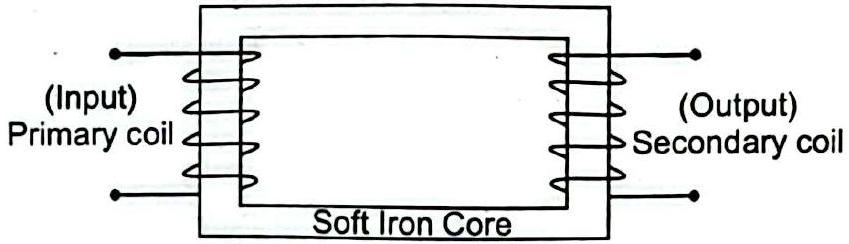
Explain, with the help of a labelled diagram, the underlying principle and working of a step-up transformer. Why can such a device not be used to step up a d.c. voltage?

Solution

Principle: A transformer works on mutual induction — a changing current in the primary sets up a changing flux in the soft-iron core that links the secondary and induces an emf in it.
Working: The primary ( turns) and secondary ( turns) are wound on a common laminated core. An alternating primary voltage drives an alternating flux shared by both coils, so

For a step-up transformer , hence . For an ideal transformer , so the stepped-up voltage comes with a reduced current.
A d.c. voltage gives a steady current and therefore a constant flux; with no emf is induced in the secondary, so a transformer cannot step up d.c.
CBSE Class 12 Board · 2007 · Subjective

More board questions on Alternating Current

  1. An a.c. voltage is applied across an ideal inductor. The current in it
    CBSE 2024View solution →
  2. (a)(i) You are given three circuit elements X, Y and Z. They are connected one by one across a given a.c. source. It is found that V and I are in phase for element X, V leads I by for element Y, while I leads V by for element Z. Identify the elemen …
    CBSE 2024View solution →
  3. (b)(i) Describe the construction and working of a transformer and hence obtain the relation for in terms of the number of turns of the primary and secondary. (ii) Discuss four main causes of energy loss in a real transformer.
    CBSE 2024View solution →
  4. A series RC circuit with and is connected across an a.c. source of peak voltage V and frequency Hz. Calculate
    (a) the impedance of the circuit (),
    (b) the phase angle (), and
    (c) the …
    CBSE 2023View solution →
  5. Laminated iron sheets are used to minimize ______ currents in the core of a transformer.
    CBSE 2020View solution →
  6. A resistance R and a capacitor C are connected in series to a source . Find: (a) the peak value of the voltage across (i) the resistance and (ii) the capacitor; (b) the phase difference between the applied voltage and the current — which of them is ahead?
    CBSE 2020View solution →