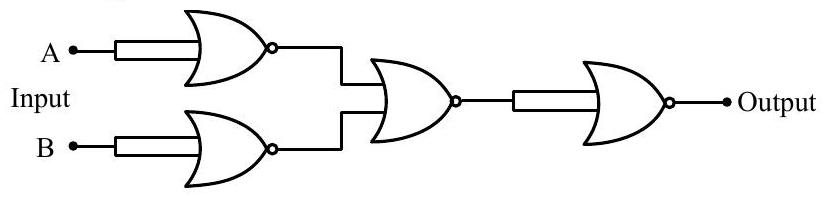
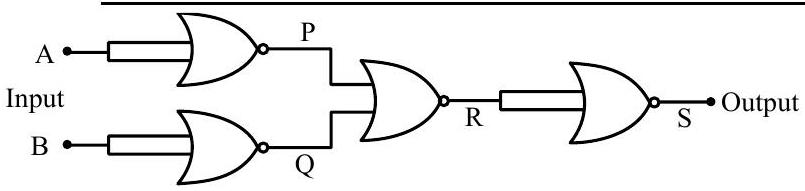
Each of the first two gates receives a single input through an OR shape carrying an inverting bubble, so it behaves as an inverter: the upper one gives Aˉ and the lower one gives Bˉ. These feed the third bubbled OR gate, whose output is Aˉ+Bˉ=A⋅B. The final gate again has a single input and an inverting bubble, so it inverts this product to give AB. A circuit whose output is AB is a NAND gate.
JEE Main · 2026 · 21 Jan 2026 · Shift 1 · Single correct option