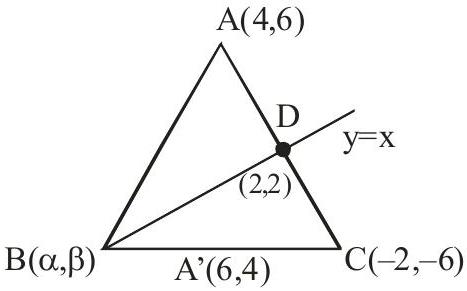
In a △ABC, suppose y=x is the equation of the bisector of the angle B and the equation of the side AC is 2x−y=2. If 2AB=BC and the points A and B are respectively (4,6) and (α,β), then α+2β is equal to
(A)42✓ Correct
(B)39
(C)48
(D)45
Answer: (A)
Solution
A(4,6); bisector of angle B is y=x; side AC: 2x−y=2.
D = intersection of the bisector with AC: substituting y=x into 2x−y=2 gives D=(2,2).
By the angle-bisector theorem, AD:DC=AB:BC. Given 2AB=BC, this ratio is 1:2, so
C=A+3(D−A)=3D−2A=(6,6)−(8,12)=(−2,−6)
Reflecting A(4,6) about the bisector y=x gives A′=(6,4); since reflecting one arm of the angle across its bisector maps it onto the other arm, A′ lies on line BC. So line BC passes through C(−2,−6) and A′(6,4):
slope=6−(−2)4−(−6)=810=45,y−4=45(x−6)
Intersecting with the bisector y=x:
x−4=45(x−6)⟹4(x−4)=5(x−6)⟹4x−16=5x−30⟹x=14
So B=(α,β)=(14,14).
α+2β=14+28=42
Key confirmed: A.
JEE Main · 2024 · 29 Jan 2024 · Shift 1 · Single correct option