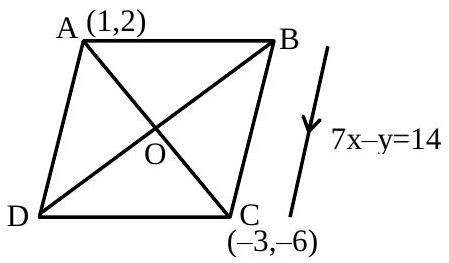
Let A(1,2) and C(−3,−6) be two diagonally opposite vertices of a rhombus, whose sides AD and BC are parallel to the line 7x−y=14. If B(α,β) and D(γ,δ) are the other two vertices, then ∣α+β+γ+δ∣ is equal to :
(A)9
(B)3
(C)6✓ Correct
(D)1
Answer: (C)
Solution
In a rhombus the diagonals bisect each other, so BD and AC share the same midpoint. The midpoint of AC is (21−3,22−6)=(−1,−2). Hence 2α+γ=−1 and 2β+δ=−2, giving α+γ=−2 and β+δ=−4. Therefore ∣α+β+γ+δ∣=∣−2−4∣=6.
JEE Main · 2026 · 23 Jan 2026 · Shift 2 · Single correct option