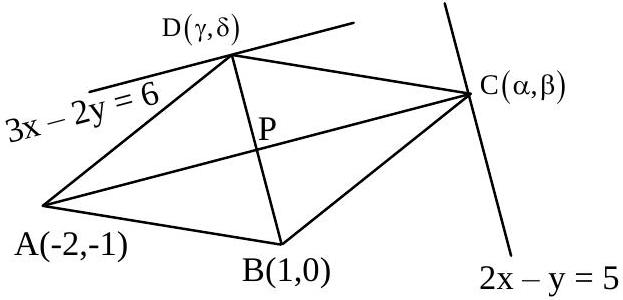
Let A(−2,−1),B(1,0),C(α,β) and D(γ,δ) be the vertices of a parallelogram ABCD . If the point C lies on 2x−y=5 and the point D lies on 3x−2y=6, then the value of ∣α+β+γ+δ∣ is equal to ______.
Answer: 32
Solution
In parallelogram ABCD, the diagonals AC and BD bisect each other, so the midpoint of AC equals the midpoint of BD:
(2α−2,2β−1)=(21+γ,2δ)
⇒α−γ=3, β−δ=1.
C(α,β) lies on 2x−y=5: 2α−β=5. D(γ,δ) lies on 3x−2y=6: 3γ−2δ=6.
From α−γ=3: γ=α−3. From β−δ=1: δ=β−1.
Substituting into 3γ−2δ=6: 3(α−3)−2(β−1)=6⇒3α−2β=13.
From 2α−β=5: β=2α−5. Substituting: 3α−2(2α−5)=13⇒−α+10=13⇒α=−3.
Then β=2(−3)−5=−11, γ=−3−3=−6, δ=−11−1=−12.
α+β+γ+δ=−3−11−6−12=−32, so ∣α+β+γ+δ∣=32.
JEE Main · 2024 · 31 Jan 2024 · Shift 2 · Integer answer