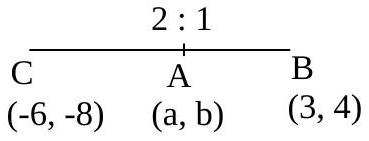
Let A(a,b), B(3,4) and (−6,−8) respectively denote the centroid, circumcentre and orthocentre of a triangle. Then, the distance of the point P(2a+3,7b+5) from the line 2x+3y−4=0 measured parallel to the line x−2y−1=0 is
(A)7155
(B)6175
(C)7175✓ Correct
(D)175
Answer: (C)
Solution
A(a,b), B(3,4), C(-6,-8) are the centroid, circumcentre and orthocentre respectively. On the Euler line, the centroid divides the segment joining the circumcentre and orthocentre in the ratio 1:2 (measured from the circumcentre).
So G=32⋅(circumcentre)+1⋅(orthocentre)=32(3,4)+(−6,−8)=3(6,8)+(−6,−8)=(0,0).
Hence a=0,b=0, so P(2a+3,7b+5)=P(3,5).
To find the distance from P(3,5) to the line 2x+3y−4=0 measured parallel to x−2y−1=0: the line x−2y−1=0 has slope 21, so its direction makes cosθ=52,sinθ=51.
A general point on the line through P in this direction is (3+52r,5+5r). Substituting into 2x+3y−4=0:
2(3+52r)+3(5+5r)−4=0
6+54r+15+53r−4=0
17+57r=0⇒r=−7175.
The required distance is ∣r∣=7175.
JEE Main · 2024 · 31 Jan 2024 · Shift 2 · Single correct option