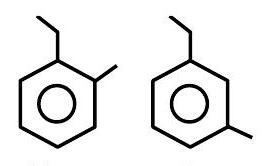
Isomeric hydrocarbons → negative Baeyer's test (Molecular formula C9H12 ) The total number of isomers from above with four different non-aliphatic substitution sites is -
Answer: 2
Solution
A negative Baeyer's test rules out any carbon–carbon multiple bond, so the isomers of C9H12 in question must be purely aromatic — a benzene ring bearing only saturated alkyl substituents. For an isomer to show four distinct (non-equivalent) aromatic C–H positions available for further electrophilic substitution, it must lack any symmetry that makes two or more ring positions equivalent. Mono-substituted isomers (propylbenzene, cumene) have only 3 distinct ring environments (ortho, meta, para), and symmetric trisubstituted or para-disubstituted isomers reduce the count further still. Only the unsymmetrically disubstituted ethyltoluenes with the two different substituents ortho or meta to each other — 1-ethyl-2-methylbenzene and 1-ethyl-3-methylbenzene — leave four chemically distinct ring hydrogens, since no symmetry element relates any pair of them. There are 2 such isomers.
JEE Main · 2025 · 29 Jan 2025 · Shift 2 · Integer answer