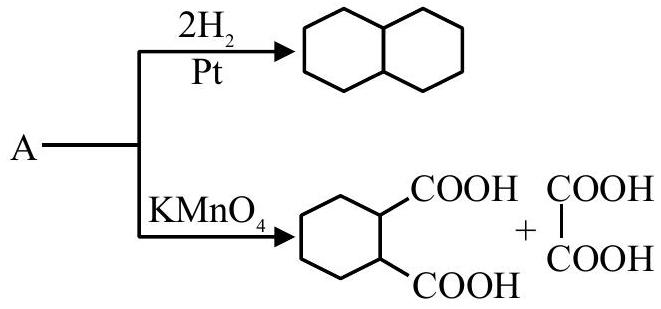
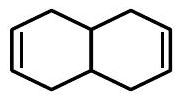
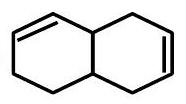
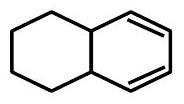
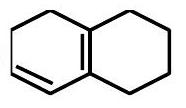
On catalytic hydrogenation A takes up two moles of hydrogen to give decahydronaphthalene, so A is an octahydronaphthalene carrying two C=C bonds. Oxidative cleavage with KMnO4 gives cyclohexane-1,2-dicarboxylic acid together with oxalic acid: the ring that survives intact as cyclohexane must bear the two carboxyl groups on its ring-fusion carbons, while the two-carbon fragment lying between the double bonds is expelled as HOOC−COOH. This demands that one ring be fully saturated and the fused ring hold a 1,3-diene, the two double bonds flanking the central C−C bond. The structure fitting both the hydrogenation and the cleavage data is the octahydronaphthalene in which a saturated cyclohexane ring is fused to a cyclohexa-1,3-diene ring.
JEE Main · 2026 · 21 Jan 2026 · Shift 1 · Single correct option