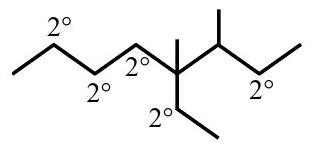
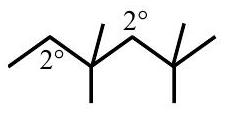
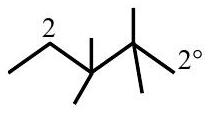
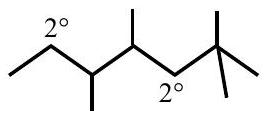
The alkane from below having two secondary hydrogens is :
(A)4-Ethyl-3,4-dimethyloctane
(B)2,2,4,4-Tetramethylhexane
(C)2,2,3,3-Tetramethylpentane✓ Correct
(D)2,2,4,5-Tetramethylheptane
Answer: (C)
Solution
A secondary hydrogen sits on a carbon bonded to exactly two other carbons, so identifying it means checking, carbon by carbon, how many carbon neighbors each one has.
4-Ethyl-3,4-dimethyloctane's long branched chain contains numerous CH2 units each flanked by two other carbons, giving many secondary hydrogens — far more than two.
2,2,4,4-Tetramethylhexane has quaternary carbons at C-2 and C-4 (each carrying two methyls plus two chain bonds); the remaining chain CH2 positions still leave more than two secondary hydrogens.
2,2,3,3-Tetramethylpentane is CH3−C(CH3)2−C(CH3)2−CH2−CH3. C-2 and C-3 are each bonded to four carbons (two chain carbons and two methyls) — quaternary, with no hydrogens at all. C-1 and the four methyl branches on C-2/C-3 are each attached to just one carbon — primary. C-5 is a terminal, primary CH3. Only C-4, the lone CH2 between C-3 and C-5, is bonded to exactly two carbons, so it alone is secondary, carrying exactly two secondary hydrogens.
2,2,4,5-Tetramethylheptane has several CH2/CH positions bonded to two carbons along its backbone, again giving more than two secondary hydrogens.
2,2,3,3-Tetramethylpentane is the alkane with exactly two secondary hydrogens.
JEE Main · 2025 · 22 Jan 2025 · Shift 2 · Single correct option