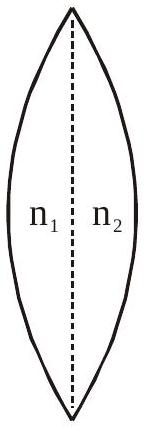
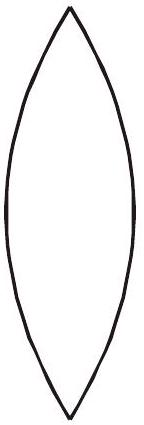
A thin convex lens is made of two materials with refractive indices n1 and n2, as shown in figure. The radius of curvature of the left and right spherical surfaces are equal. f is the focal length of the lens when n1=n2=n. The focal length is f+Δf when n1=n and n2=n+Δn. Assuming Δn≪ (n-1) and 1 < n < 2, the correct statement(s) is/are :
(A)The relation between fΔf and nΔn remains unchanged if both the convex surfaces are replaced by concave surfaces of the same radius of curvature.✓ Correct
(B)fΔf<nΔn
(C)For n=1.5,Δn=10−3 and f=20cm, the value of ∣Δf∣ will be 0.02 cm (round off to 2nd decimal place)✓ Correct
(D)If nΔn<0 then fΔf>0✓ Correct
Answer: (A), (C), (D)
Solution
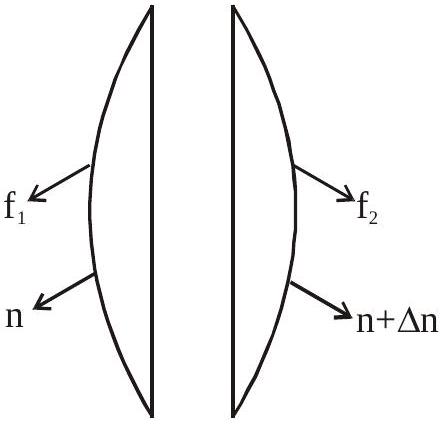
When n1=n2=n, f1=(n−1)R2. Replacing the right half's index by n+Δn adds RΔn to the power, so fΔf=−2(n−1)Δn. This relation contains no R, so it is unchanged if the surfaces become concave of the same radius, and it shows that a negative nΔn makes fΔf positive. For n=1.5, Δn=10−3 and f=20 cm, ∣Δf∣=2(n−1)fΔn=2×0.520×10−3=0.02 cm. The inequality fΔf<nΔn does not hold, since for 1<n<2 one has 2(n−1)1>n1.
JEE Advanced · 2019 · 27 May 2019 · Paper 1 · One or more correct options