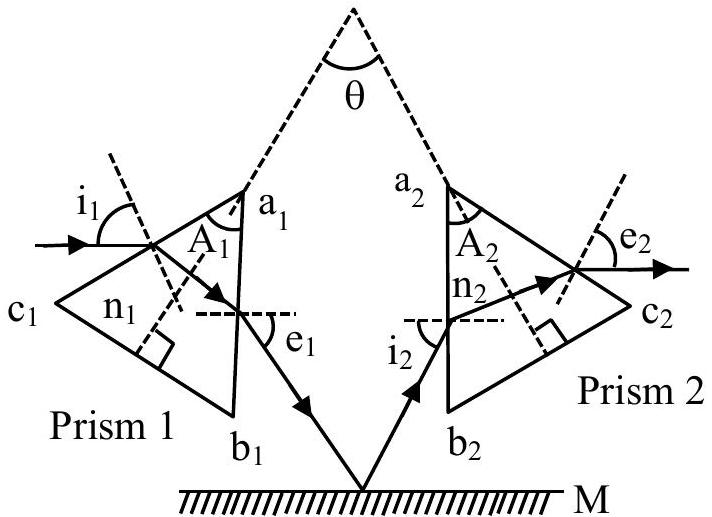
Consider two isosceles prisms 1 and 2 with prism angles A1 and A2 and refractive indices n1 and n2, respectively, as shown in the figure. The faces a1b1 and a2b2 are parallel to each other and perpendicular to the mirror M. If a ray of light is incident on the face a1c1 and emerges from the face a2c2, then the correct statement(s) is/are:
(A)If both the prisms are at minimum deviation condition, then n1n2=sin(2A1)/sin(2A2)✓ Correct
(B)If prism 2 is at minimum deviation condition, then sini1=n2sin(2A2) is always true.
(C)If both the prisms 1 and 2 are thin and are at minimum deviation condition with angles of deviation δm1 and δm2, respectively, then θ=2(n1−1)δm1+2(n2−1)δm2.✓ Correct
(D)If prism 1 is at minimum deviation condition, then sini2=n1sin(2A1) is always true.✓ Correct
Answer: (A), (C), (D)
Solution
By symmetry, when both prisms are at minimum deviation: i1=e1=i2=e2. Applying Snell's law: sini1=n1sin(A1/2) and sini2=n2sin(A2/2). Since i1=i2, we get n1n2=sin(A2/2)sin(A1/2). Option (A) is correct.
For option (B), if only prism 2 is at minimum deviation, i2=e2 but i1=e1, so i1=i2. Thus sini1=n2sin(A2/2). Option (B) is incorrect.
For option (C), with both at minimum deviation: δm1=(n1−1)A1 and δm2=(n2−1)A2. The angle θ=2A1+2A2=21(n1−1δm1+n2−1δm2). Option (C) is correct.
For option (D), if prism 1 is at minimum deviation, i1=e1=i2 (by symmetry), so sini2=n1sin(A1/2). Option (D) is correct.
JEE Advanced · 2026 · 17 May 2026 · Paper 2 · One or more correct options