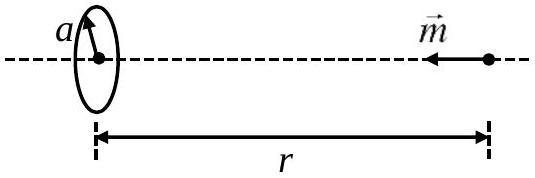
A special metal S conducts electricity without any resistance. A closed wire loop, made of S, does not allow any change in flux through itself by inducing a suitable current to generate a compensating flux. The induced current in the loop cannot decay due to its zero resistance. This current gives rise to a magnetic moment which in turn repels the source of magnetic field or flux. Consider such a loop, of radius a, with its center at the origin. A magnetic dipole of moment m is brought along the axis of this loop from infinity to a point at distance r(≫a) from the center of the loop with its north pole always facing the loop, as shown in the figure below. The magnitude of magnetic field of a dipole m, at a point on its axis at distance r, is 2πμ0r3m, where μ0 is the permeability of free space. The magnitude of the force between two magnetic dipoles with moments, m1 and m2, separated by a distance r on the common axis, with their north poles facing each other, is r4km1m2, where k is a constant of appropriate dimensions. The direction of this force is along the line joining the two dipoles.
When the dipole m is placed at a distance r from the center of the loop (as shown in the figure), the current induced in the loop will be proportional to
(A)r3m✓ Correct
(B)r2m2
(C)r2m
(D)rm2
Answer: (A)
Solution
The magnetic field at the center of the loop due to the dipole is:
B=2πμ0r3m
The flux through the loop of area πa2 is:
ϕ=B×πa2=2πr3μ0mπa2=2r3μ0ma2
For a superconducting loop, the flux is conserved by inducing a current. The flux due to the induced current must equal the external flux:
ϕ=Li
where L is the self-inductance of the loop.
Therefore:
i=Lϕ=2Lr3μ0ma2
Since μ0, a, and L are constants:
i∝r3m
Correct answer: (A)
JEE Advanced · 2021 · 03 Oct 2021 · Paper 2 · Single correct option