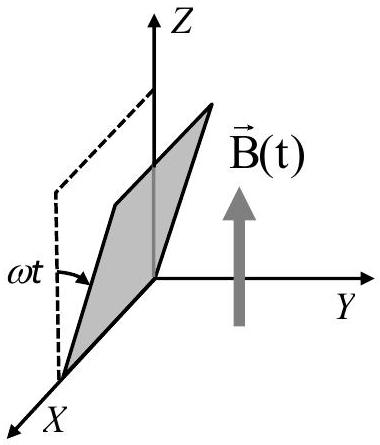
A conducting square loop initially lies in the XZ plane with its lower edge hinged along the X-axis. Only in the region y≥0, there is a time dependent magnetic field pointing along the Z-direction, B(t)=B0(cosωt)K^, where B0 is a constant. The magnetic field is zero everywhere else. At time t=0, the loop starts rotating with constant angular speed ω about the X axis in the clockwise direction as viewed from the +X axis (as shown in the figure). Ignoring self-inductance of the loop and gravity, which of the following plots correctly represents the induced e.m.f. (V) in the loop as a function of time:
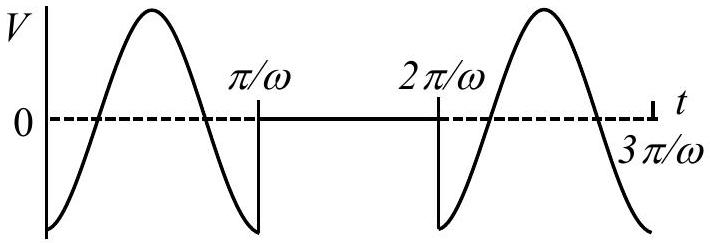
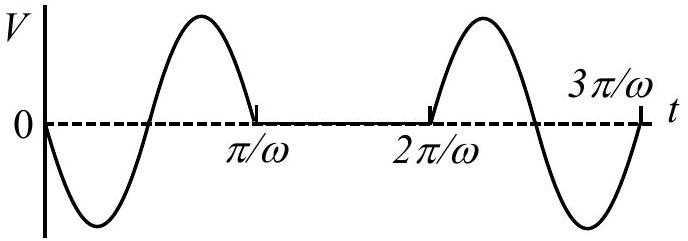
(A)(see structure)✓ Correct
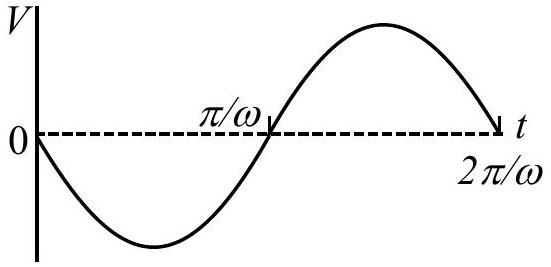
(B)(see structure)
(C)(see structure)
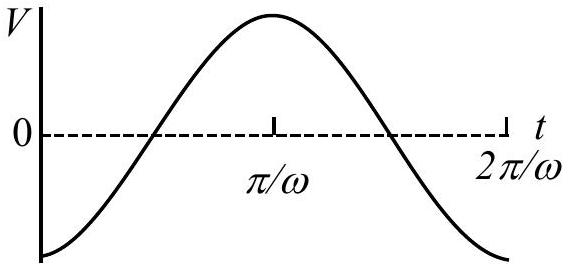
(D)(see structure)
Answer: (A)
Solution
The magnetic flux through the loop is:
ϕ=B0cosωt⋅Asinωt=2B0Asin2ωt
This is valid for 0≤t≤ωπ when the loop is in the region y≥0.
The induced emf is:
ε=−dtdϕ=−B0Aωcos2ωt
For ωπ≤t≤ω2π, the loop is in the region y<0 where B=0, so ε=0.
This pattern repeats with period ω2π. Option (A) correctly shows this behavior.
JEE Advanced · 2025 · 18 May 2025 · Paper 1 · Single correct option