Considering the following reaction sequence, the correct statement(s) is(are)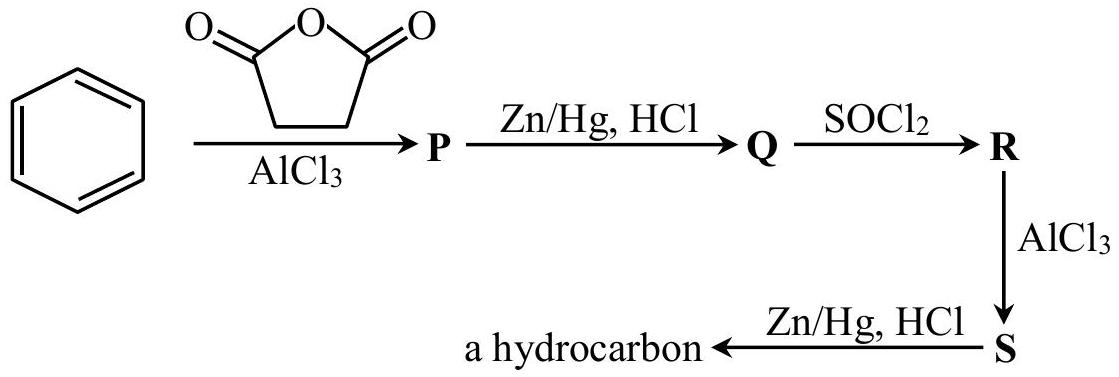
- (A)Compounds and are carboxylic acids.✓ Correct
- (B)Compound decolorizes bromine water.
- (C)Compounds and react with hydroxylamine to give the corresponding oximes.✓ Correct
- (D)Compound reacts with dialkylcadmium to give the corresponding tertiary alcohol.
Answer: (A), (C)
Solution
From the reaction sequence, compound P is a carboxylic acid and Q is also a carboxylic acid. Option (A) is correct.
Compound S is a ketone (not an alkene), so it does not decolorize bromine water. Option (B) is incorrect.
Both P (if it contains a carbonyl after certain transformations) and S (a ketone) can react with hydroxylamine to form oximes. Option (C) is correct.
Compound R is an acid chloride. Acid chlorides react with dialkylcadmium to give ketones, not tertiary alcohols. Option (D) is incorrect.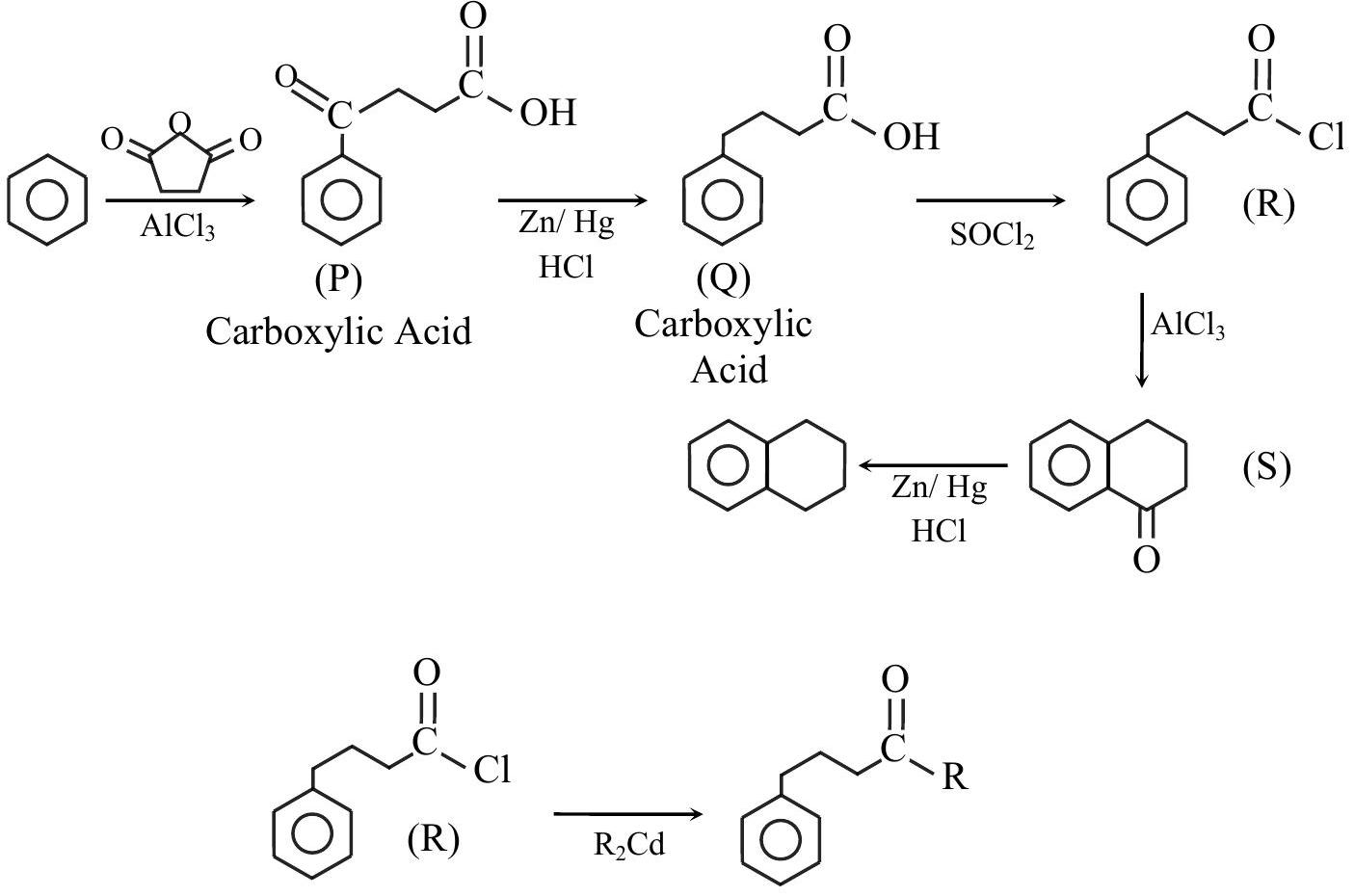
Compound S is a ketone (not an alkene), so it does not decolorize bromine water. Option (B) is incorrect.
Both P (if it contains a carbonyl after certain transformations) and S (a ketone) can react with hydroxylamine to form oximes. Option (C) is correct.
Compound R is an acid chloride. Acid chlorides react with dialkylcadmium to give ketones, not tertiary alcohols. Option (D) is incorrect.
JEE Advanced · 2022 · 28 Aug 2022 · Paper 2 · One or more correct options