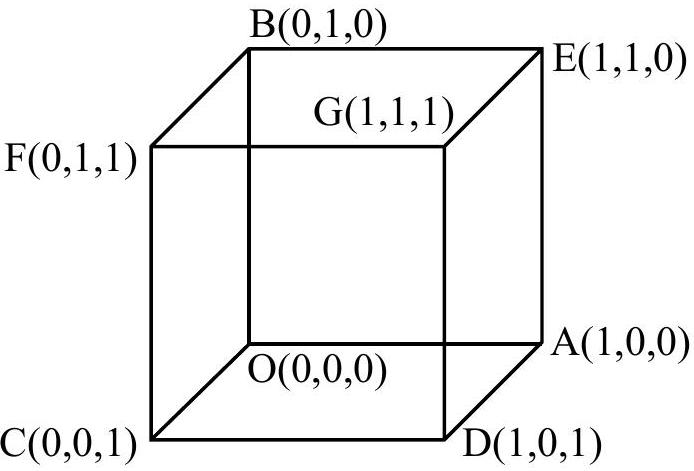
Let Q be the cube with the set of vertices {(x1,x2,x3)∈R3:x1,x2,x3{0,1}}. Let F be the set of all twelve lines containing the diagonals of the six faces of the cube Q. Let S be the set of all four lines containing the main diagonals of the cube Q; for instance, the line passing through the vertices (0, 0,0) and (1,1,1) is in S. For lines ℓ1 and ℓ2, let d(ℓ1,ℓ2) denote the shortest distance between them. Then the maximum value of d(ℓ1,ℓ2), as ℓ1 varies over F and ℓ2 varies over S, is
(A)61✓ Correct
(B)81
(C)31
(D)121
Answer: (A)
Solution
Consider the main diagonal OG from (0,0,0) to (1,1,1) with direction ratios (1,1,1).
Consider a face diagonal AB from (1,0,0) to (1,1,1) with direction ratios (0,1,1) (or equivalently (1,−1,0) for edge from (1,0,0) to (0,1,0)).
For line OG: 1x=1y=1z
For line AB (say from (1,0,0) with direction (1,−1,0)): 1x−1=−1y=0z
The normal to both lines is:
n=i^11j^1−1k^10=i^+j^−2k^
The shortest distance is:
d=∣n∣∣OA⋅n∣=1+1+4∣i^⋅(i^+j^−2k^)∣=61
Answer: (A)
JEE Advanced · 2023 · 04 Jun 2023 · Paper 1 · Single correct option