Let R3 denote the three-dimensional space. Take two points P=(1,2,3) and Q=(4,2,7). Let dist (X, Y) denote the distance between two points X and Y in R3. Let S={X∈R3:(dist(X,P))2−(dist(X,Q))2=50} and T={Y∈R3:(dist(Y,Q))2−(dist(Y,P))2=50}. Then which of the following statements is (are) TRUE ?
(A)There is a triangle whose area is 1 and all of whose vertices are from S.✓ Correct
(B)There are two distinct points L and M in T such that each point on the line segment LM is also in T .✓ Correct
(C)There are infinitely many rectangles of perimeter 48, two of whose vertices are from S and the other two vertices are from T.✓ Correct
(D)There is a square of perimeter 48, two of whose vertices are from S and the other two vertices are from T.✓ Correct
(A) Since S is a plane, we can find three non-collinear points forming a triangle of area 1. TRUE.
(B) Any two distinct points L,M∈T lie on the plane T, so the line segment LM lies entirely in T. TRUE.
(C) The distance between the parallel planes S and T is:
d=36+64∣105−5∣=10100=10
For a rectangle with perimeter 48 and two vertices on each plane, if the sides perpendicular to the planes have length 10, then the other two sides have total length 248−20=14. There are infinitely many such rectangles. TRUE.
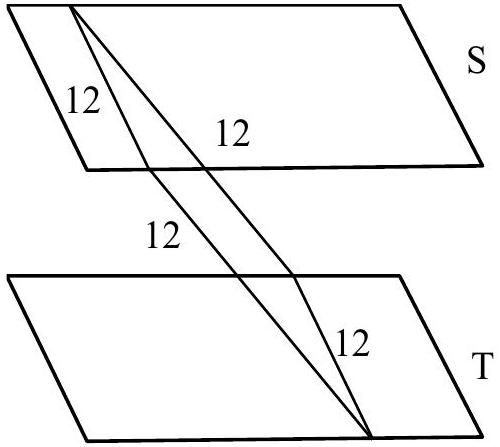
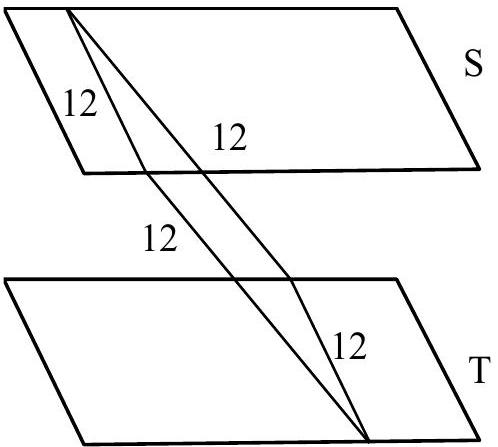
(D) For a square with perimeter 48, each side has length 12. If two opposite vertices are on S and the other two on T, the diagonal connecting vertices on different planes has length 122. The perpendicular distance between planes is 10. Using the Pythagorean theorem in the plane perpendicular to both S and T, we can verify such a square exists. TRUE.
JEE Advanced · 2024 · 26 May 2024 · Paper 1 · One or more correct options