Let L1 be the line of intersection of the planes given by the equations
2x+3y+z=4 and x+2y+z=5.
Let L2 be the line passing through the point P(2,−1,3) and parallel to L1. Let M denote the plane given by the equation
2x+y−2z=6
Suppose that the line L2 meets the plane M at the point Q. Let R be the foot of the perpendicular drawn from P to the plane M. Then which of the following statements is (are) TRUE ?
(A)The length of the line segment PQ is 93✓ Correct
(B)The length of the line segment QR is 15
(C)The area of △PQR is 23234✓ Correct
(D)The acute angle between the line segments PQ and PR is cos−1(231)
Answer: (A), (C)
Solution
Direction ratios of L1 (cross product of normals): b=i^−j^+k^, so L1 has direction ⟨1,−1,1⟩.
L2 passes through P(2,−1,3) with the same direction:
1x−2=−1y+1=1z−3=λ
Point on L2: (λ+2,−λ−1,λ+3). Substituting into plane M:2x+y−2z=6:
2(λ+2)−λ−1−2(λ+3)−6=0⟹λ=−9
So Q(−7,8,−6).
PQ=(−9)2+92+(−9)2=93. (A) is true.
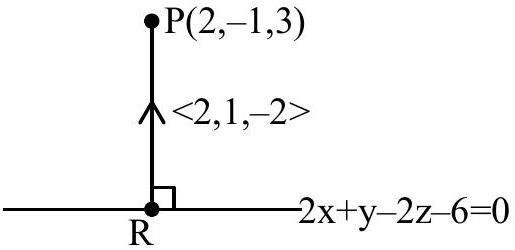
For R, perpendicular from P to M has direction ⟨2,1,−2⟩:
2x−2=1y+1=−2z−3=μ
Substituting into M: μ=1, so R(4,0,1).
QR=112+(−8)2+72=234. (B) is false.
Area of △PQR=21∣QP×QR∣=23234. (C) is true.
Angle: cosθ=∣PQ∣∣PR∣∣PQ⋅PR∣=93⋅39=331. (D) is false.
JEE Advanced · 2025 · 18 May 2025 · Paper 1 · One or more correct options