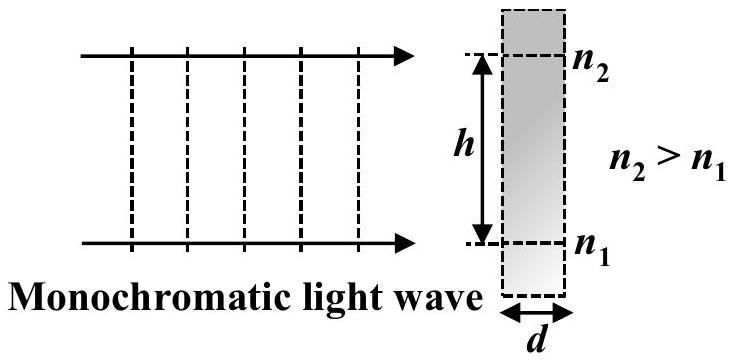
A monochromatic light wave is incident normally on a glass slab of thickness d , as shown in the figure. The refractive index of the slab increases linearly from n1 to n2 over the height h . Which of the following statement(s) is (are) true about the light wave emerging out of the slab ?
(A)It will deflect up by an angle tan−1[2h(n22−n12)d]
(B)It will deflect up by an angle tan−1[h(n2−n1)d]✓ Correct
(C)It will not deflect.
(D)The deflection angle depends only on (n2−n1) and not on the individual values of n1 and n2.✓ Correct
Answer: (B), (D)
Solution
As the light travels through the slab with varying refractive index, it bends toward regions of higher refractive index.
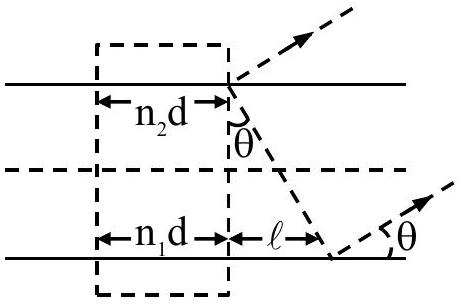
The optical path difference across the slab causes a lateral shift. Using Fermat's principle and the geometry:
n1d+ℓ=n2d
where ℓ is the lateral displacement. This gives ℓ=(n2−n1)d.
The deflection angle is: tanθ=hℓ=h(n2−n1)d
Therefore θ=tan−1[h(n2−n1)d].
The angle depends only on the difference (n2−n1), not on individual values.
JEE Advanced · 2023 · 04 Jun 2023 · Paper 2 · One or more correct options