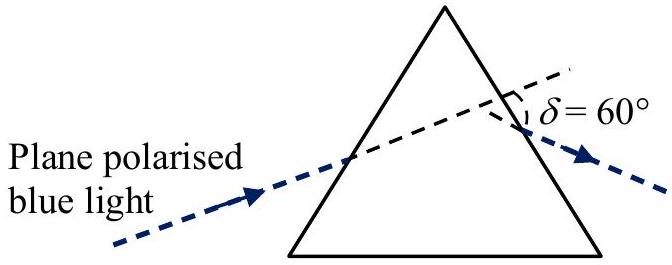
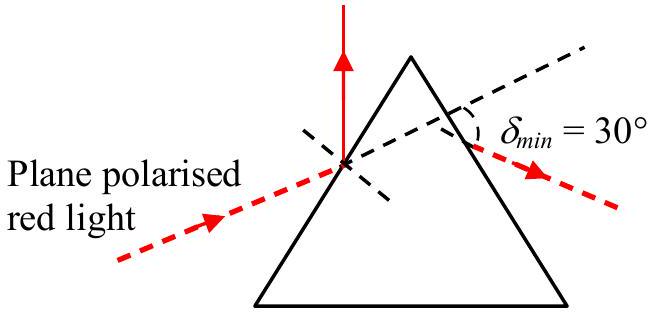
A plane polarized blue light ray is incident on a prism such that there is no reflection from the surface of the prism. The angle of deviation of the emergent ray is δ=60∘ (see Figure-1). The angle of minimum deviation for red light from the same prism is δmin=30∘ (see Figure-2). The refractive index of the prism material for blue light is 3. Which of the following statement(s) is(are) correct?Figure-1Figure-2
(A)The blue light is polarized in the plane of incidence.✓ Correct
(B)The angle of the prism is 45°.
(C)The refractive index of the material of the prism for red light is 2.✓ Correct
(D)The angle of refraction for blue light in air at the exit plane of the prism is 60∘.✓ Correct
Answer: (A), (C), (D)
Solution
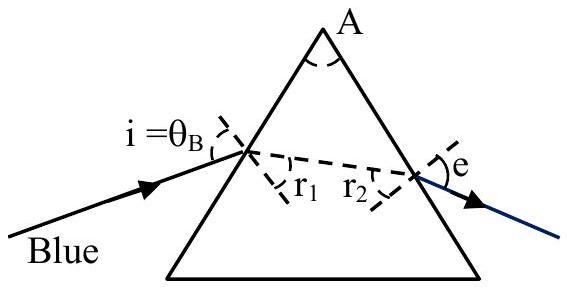
Since there is no reflection from the surface, the incident angle equals Brewster's angle: tanθB=μB=3, giving i=θB=60°. At Brewster's angle, the reflected light would be polarized perpendicular to the plane of incidence, but since there's no reflection, the transmitted light is polarized in the plane of incidence. Option (A) is correct.
Applying Snell's law at entry: sin60°=3sinr1, giving r1=30°.
Using the deviation formula: δ=(i+e)−A, we have 60°=60°+e−A, so e=A.
At exit: 3sinr2=sine=sinA.
Since r1+r2=A and r1=30°, we have r2=A−30°.
Substituting: 3sin(A−30°)=sinA.
Expanding and solving gives A=60°, so e=60°. Options (B) is incorrect (should be 60°, not 45°), and (D) is correct.
For red light at minimum deviation: μR=sin2Asin2A+δmin=sin30°sin45°=1/21/2=2. Option (C) is correct.
JEE Advanced · 2023 · 04 Jun 2023 · Paper 1 · One or more correct options