JEE Main · 2019 · 11 Jan 2019 · Shift 2 · Straight Lines

WhatsApp Email
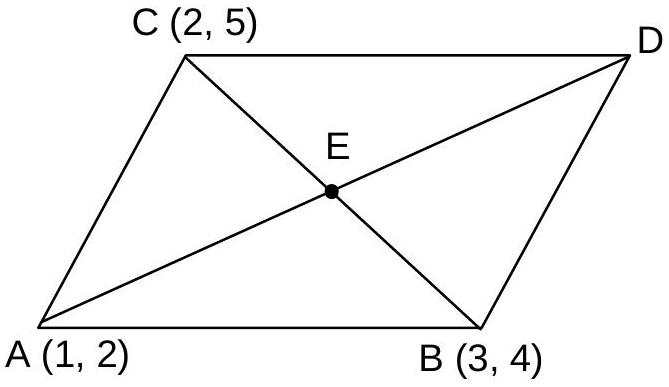
If in a parallelogram ABDC, the coordinates of A, B and C are respectively (1, 2), (3, 4) and (2, 5), then the equation of the diagonal AD is:
  1. (A)✓ Correct
  2. (B)
  3. (C)
  4. (D)

Answer: (A)

Solution

In the parallelogram ABDC the vertices run A, B, D, C, so the diagonals are AD and BC and they bisect each other. The midpoint of BC, with B and C, is , and this is also the midpoint of AD; with A that fixes D. The slope of AD is , so through A the diagonal is , i.e. .

JEE Main · 2019 · 11 Jan 2019 · Shift 2 · Single correct option
More JEE Main questions on Straight Lines

  1. Let a point A lie between the parallel lines and such that its distances from and are 6 and 3 units, respectively. Then the area (in sq. units) of the equilateral triangle ABC , where the points B and C l …
    JEE Main 2026View solution →
  2. Among the statements
    (S1): If and are two vertices of a triangle, whose orthocentre is , then its third vertex is and
    (S2): If positive numbers are three consecutive terms of an A.P., then the lines are …
    JEE Main 2026View solution →
  3. A rectangle is formed by the lines , , and . Let the line L be perpendicular to and divide the area of the rectangle into two equal parts. Then the distance of the point …
    JEE Main 2026View solution →
  4. Let and be two diagonally opposite vertices of a rhombus, whose sides AD and BC are parallel to the line . If and are the other two vertices, then …
    JEE Main 2026View solution →
  5. Let and be three points. If the equation of the bisector of the angle ABC is , then the value of is
    JEE Main 2026View solution →
  6. Let the angles made with the positive x-axis by two straight lines drawn from the point and meeting the line at a distance from the point P be and . Then the value of …
    JEE Main 2026View solution →