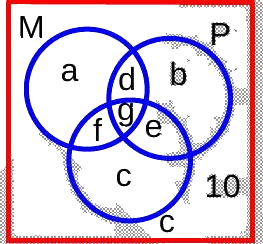
In a survey of 220 students of a higher secondary school, it was found that at least 125 and at most 130 students studied Mathematics; at least 85 and at most 95 studied Physics; at least 75 and at most 90 studied Chemistry; 30 studied both Physics and Chemistry; 50 studied both Chemistry and Mathematics; 40 studied both Mathematics and Physics and 10 studied none of these subjects. Let m and n respectively be the least and the most number of students who studied all the three subjects. Then m+n is equal to ____.
Answer: 45
Solution
Let x be the number studying all three. Using ∣M∪P∪C∣=220−10=210 and inclusion–exclusion with the pairwise overlaps 40,30,50:
∣M∣+∣P∣+∣C∣+120−2x=210⇒∣M∣+∣P∣+∣C∣−2x=90.
Applying the given ranges for ∣M∣,∣P∣,∣C∣ and the constraint 30−x≥0 yields 15≤x≤30. Least m=15, most n=30, so m+n=45. Answer: 45.