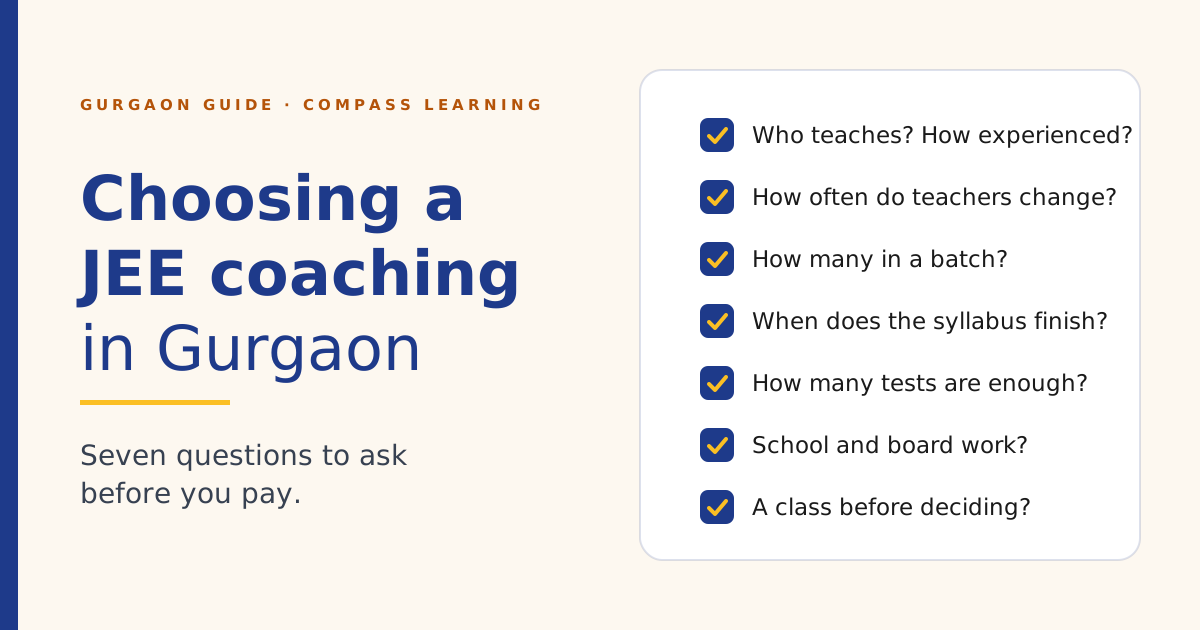
Every JEE institute in Gurgaon has a good brochure. Results on the front, a scholarship offer inside, a deadline on the back. The brochure does not tell you what the next two years will be like for your child. These seven questions do. Ask them at every institute you visit, including ours.
1. Who will teach my child, and what is their experience?
Ask for the names of the teachers who will take your child's batch, not the names on the hoarding. Then ask about each one: how many years they have taught JEE, and where they studied.
This matters because many large institutes keep a few experienced teachers for the top batches and for the demo class, and give the other batches to junior teachers in their first or second year of teaching. The senior teacher you met at counselling may never enter your child's classroom. Ask plainly: who takes this batch, in each subject, through the year?
2. How often do teachers change?
Ask how long the present teachers have been with the institute, and how many times a teacher was changed in a batch last year. A new teacher in the middle of the session means a new method, a new pace, and several weeks lost while the student adjusts. An institute whose teachers stay is telling you something about how it is run.
3. How many students are in a batch?
A batch of sixty and a batch of fifteen are different experiences. In a small batch the teacher knows which student has stopped following, and the chapter can be completed in class. Ask for the actual number in the batch your child would join, and ask to see the classroom.
4. When will the syllabus finish, and at what pace?
Ask for the dates: when the Class XI syllabus ends, and when the Class XII syllabus ends. Many institutes go slowly in the first months and then rush through the last chapters. Others finish the Class XII syllabus so late that the student has little time left for advanced-level problems and for practising previous-year papers, which is where the rank is actually made.
A steady pace from the first month, and a Class XII syllabus that ends well before the exams, is worth more than any number of extra lectures at the end.
5. How many tests are enough?
Tests matter, but only for a student who has had time to study. A test checks what has been learnt; it does not do the learning. When tests come so often that there is no time left to revise and practise, they stop helping.
This has become common because online tests are cheap to create and cheap to conduct, so many institutes assign one test series after another. It happens most in Class XII, exactly when a student needs time to revise. The student ends up writing paper after paper, with no time to go back to the chapters where the marks were lost.
So ask: how many test series does the institute run, and why each one? Does it check whether the tests are improving the students, or does it run them for the sake of running tests?
Ask about difficulty too. Some institutes set very hard papers from the first month. Students then fall into the habit of chasing difficult questions and difficult books before the concept is clear, and their confidence suffers. Tests should have a purpose, and their difficulty should rise step by step as the concepts settle.
6. What happens to school and board work?
Class XI and XII students have school exams, practicals and the board examination. Ask how the institute handles these. If the answer is "that is the school's job", your child will need a second tuition by October.
7. Can my child sit in a class before we decide?
Ask how a demo class works. A demo held in a real, running batch, by the teacher who will actually take that batch, tells you far more than a special lecture arranged for visitors.
How we answer these at Compass Learning
It is only fair that we answer our own questions.
- Teachers: three senior teachers, for Mathematics, Physics and Chemistry. They are IIT and NIT graduates, each has headed a department at a leading JEE institute, and each has taught JEE for well over a decade. They take every class themselves, in every batch.
- Stability: the same teachers have been teaching students in Gurgaon for more than ten years. A batch keeps its teachers through the session.
- Batch size: around 15 students.
- Pace: the Class XII syllabus is completed by mid-October. That leaves time for revision, advanced-level problems and previous-year papers. The syllabus has been completed on time every year.
- Tests: one test a week on recent topics, and phase tests in the JEE pattern after each group of chapters, with days kept free before each phase test to prepare. Difficulty is raised step by step. We do not add tests beyond these unless a batch needs them.
- School and boards: covered inside the JEE batches.
- Demo: admission is through an admission test; after the test your child attends a free demo class in the batch that suits them.
Admissions for the 2027-28 session are open. Batches, the admission test and the registration form are on our Admissions 2027-28 page. We are at C 702, Nirvana Courtyard, Sector 50, Gurugram; please call before visiting so that a teacher is free to meet you.


