Plaksha University: A Profile of the Tech-First Private University at Mohali
A genuinely new institute with a specific thesis
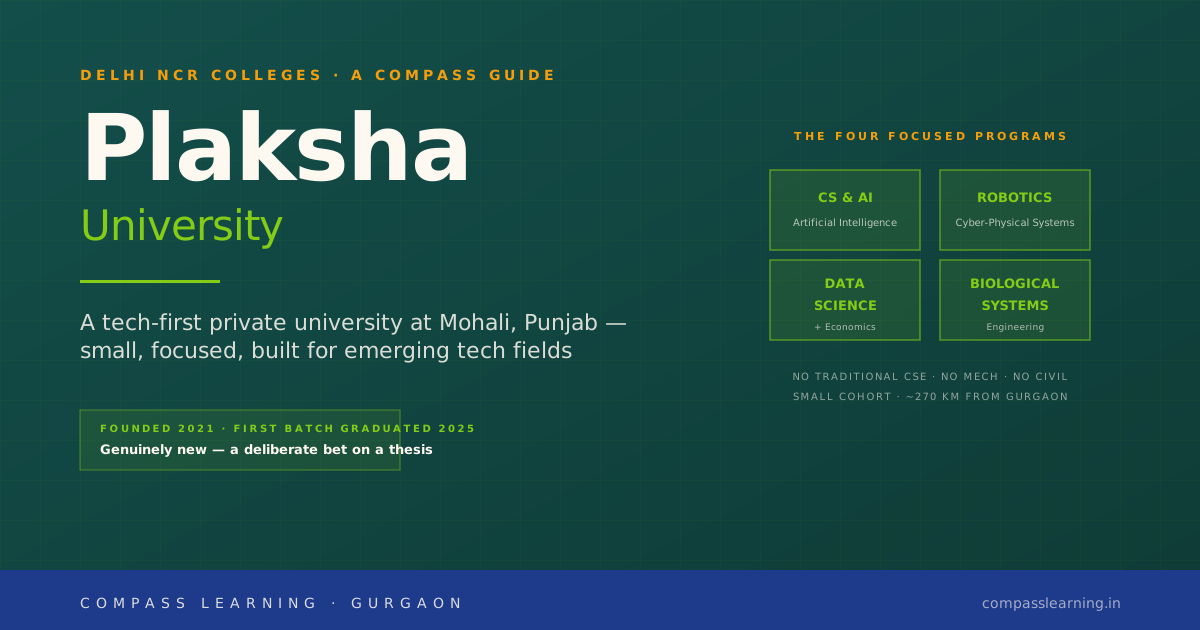
Plaksha University took its first batch of undergraduates in 2021. As of now, it has only a handful of graduating batches — the longest-tenured alumni are roughly three to four years past graduation. By traditional measures of institutional maturity (placement track record, senior alumni network, established research reputation), Plaksha is genuinely young.
What makes the university worth profiling alongside more established options is its thesis. Plaksha was founded by a collective of Indian tech entrepreneurs and academics — including Vineet Gupta, Sanjeev Bikhchandani (Naukri), Ashish Dhawan, and several others — with the explicit goal of building a private engineering university focused entirely on emerging technology areas: AI, robotics, data science, biological systems engineering. The institute is small, residential, and modelled in part on global tech-focused universities like Olin College in the US.
This article walks through what Plaksha actually is today, how admissions work, what the academic experience looks like, and how to think honestly about the trade-offs of choosing a newer institute.
Note: This article is written to be evergreen, but specific dates, fees, eligibility thresholds, and program details are set each year by the university. Always cross-check the latest official notifications before acting on anything time-sensitive.
About the university
Plaksha's distinguishing structural features:
- Founded 2021 — significantly younger than even Bennett (2016). Plaksha is in the early-establishment phase as an institute.
- Located at Mohali, Punjab — approximately 270 km from Gurgaon, near Chandigarh. This is not Delhi NCR. Despite being included in this guide because some Gurgaon families consider it, the location is meaningfully different from the other options profiled.
- Engineering-first and emerging-tech-focused — Plaksha doesn't offer traditional branches like Civil or Mechanical. The programme list is built around emerging technology areas.
- Small and selective — total BTech intake is in the low hundreds per year, smaller than even SNU
- Fully residential — students live on campus throughout the programme
- Foundation-funded — backed by significant endowment from founding philanthropists, which supports scholarship programs
The institute positions itself for students drawn specifically to AI, robotics, computational biology, and similar emerging fields — and for families willing to take a deliberate bet on a newer institute with a specific thesis rather than a more established generalist option.
How admissions work
Plaksha uses its own admissions process:
- Entrance: Plaksha Common Test (PCT), or JEE Main, or SAT scores
- Class XII boards: PCM aggregate considered (typically 70%+ for general)
- Holistic component: Application essays, recommendations, interviews factored in
- Counselling: Plaksha runs its own admission cycle, separate from JoSAA
The holistic component is real here — Plaksha looks at the full applicant profile, similar to SNU and Ashoka. Strong test scores alone don't guarantee admission; thin profiles need to be compensated by other strengths.
Programs offered
Plaksha's BTech offerings are deliberately narrow and focused on emerging tech:
- BTech in Computer Science and Artificial Intelligence
- BTech in Robotics and Cyber-Physical Systems
- BTech in Data Science, Economics, and Business
- BTech in Biological Systems Engineering
Notable absences: there is no general "CSE", "Mechanical Engineering", "Civil Engineering", or "Electrical Engineering" at Plaksha. The university has deliberately chosen not to offer these traditional branches in favour of specialised emerging-tech programmes.
This is a real curricular philosophy choice. A "BTech in CSE-AI" at Plaksha is structurally an AI-focused degree from the start, not a CSE degree with AI electives. Whether this is an advantage or a disadvantage depends on what you want — for students sure they want AI specifically, the focused curriculum is genuinely valuable; for students wanting broader CS exposure with optional specialisation, the structure may feel restrictive.
Cutoffs and competitiveness
Because Plaksha is new and uses its own admissions, traditional closing-rank data isn't available in the same way. Rough indicators from recent cycles:
- All BTech programs: typically JEE Main ~92+ percentile or equivalent strong PCT/SAT performance, plus a strong overall profile
- Acceptance rates: Very low — Plaksha admits a small cohort each year and has been selective from the start
Because the cohort is small, individual admissions are competitive even though the institute is young. Students considering Plaksha need to invest in the full application process — essays and interviews matter substantially.
Campus, hostel, and student life
The Mohali campus is purpose-built and modern, designed around innovation/maker culture:
- Hostels: Fully residential; on-campus accommodation for all students
- Academic facilities: Modern labs including dedicated AI labs, robotics labs, fabrication facilities (maker spaces); strong emphasis on hands-on building
- Class sizes: Small, with low faculty-to-student ratios — closer to a top liberal arts college than a large engineering institute
- Industry exposure: Regular speakers from Indian and international tech industry, given the founder network
- Student culture: Entrepreneurship-oriented; many students engaged in side projects, startups, or research alongside coursework
The small institute size means every student gets significant faculty attention and there's real flexibility for self-directed learning. This is one of Plaksha's most concrete advantages over larger institutes.
Placements
Plaksha's placement track record is genuinely limited at this point — the first batch graduated only in 2025, and the full first cohort's outcomes are only partially documented.
What is visible from early data:
- Average package (where reported): comparable to mid-tier private engineering universities, with some high-end offers
- Top recruiters: Includes some major tech companies, but the recruiter network is still being built
- Graduate school placements: Some early graduates have gone to MS programmes at top international universities
The honest framing here is: there is not yet enough data to confidently characterise Plaksha's placement outcomes the way you can for DTU, NSUT, or even Bennett. The first few batches' results are encouraging in absolute terms, but the long-term trajectory of an institute typically isn't visible until 5-10 batches have graduated and moved into senior roles. Plaksha is still in the early years of building that picture.
For students considering Plaksha, accept that you are choosing partly on the basis of the institute's thesis and faculty quality rather than placement statistics. If placement track record is your primary decision factor, more established institutes are the safer choice.
Fees and financial aid
Plaksha's fee structure is in the upper range for Indian private universities:
- Tuition + academic charges: ~₹6 lakh per year
- Hostel + mess: additional ~₹2-3 lakh per year
- Four-year total: typically ₹32-38 lakh including hostel
This is comparable to SNU and below Ashoka.
Scholarships matter significantly. Plaksha has a substantial scholarship program funded by its founding philanthropists, including:
- Plaksha Scholar awards — full or substantial partial scholarships for top admits
- Need-based aid for students with documented financial need
- Various merit categories at different aid levels
For students with strong profiles, applying for scholarship during admissions is essential — many admitted students receive substantial aid.
For Gurgaon students specifically
Plaksha's location at Mohali is the longest distance among the options in this guide:
Commute:
- By road: ~250-270 km via NH-44; not a realistic commute by any measure
- By train: Multiple options to Chandigarh; then road transit to campus
- By air: Chandigarh airport, ~30 minutes from campus
- Reality check: Plaksha is geographically far from Gurgaon. Plan as you would for an out-of-state university — students travel home during breaks rather than visiting regularly.
Residential expectation: Fully residential, no daily-visit option.
Alumni in Gurgaon: Very limited — institute is too young for significant alumni footprint anywhere yet, including Gurgaon. The founder network does provide some industry connection, but that's different from a deep alumni base.
What to know before committing
A few items to weigh carefully:
- The institute is very new. Founded 2021. The faculty quality is genuinely high (recruited from top global institutions), and the funding is solid, but the institute hasn't yet been tested through the full multi-decade cycle that builds a mature reputation. This is a real bet, not a settled choice.
- The programme structure is narrow. If you join expecting general CS or general engineering and then decide AI/robotics isn't what you want, you cannot easily switch to a different branch the way you can at DTU or even SNU. The branch options are limited and specialised by design.
- The location is far. Don't underestimate the distance. For students leaving home for the first time, the logistical and emotional distance from family in Gurgaon is material.
- The market recognition is still being built. Recruiters who screen by college name are still learning what a "Plaksha graduate" means. For early-career roles, this can mean more variability in outcomes than at established institutes.
Is Plaksha the right fit?
The university is a reasonable fit if:
- You are genuinely drawn to AI, robotics, computational biology, or similar emerging-tech fields — not just engineering broadly
- You value small class sizes and high faculty attention
- You are willing to bet on a newer institute with a specific thesis, accepting the trade-off of less established placement data
- You qualify for substantial scholarship aid making the fee workable, or your family can comfortably bear the full cost
- You are comfortable being far from home, including from Delhi NCR
- You see undergrad as a launching point for grad school or research, where the small-cohort high-attention model has clear advantages
The fit is less clear if:
- You want general CS, ECE, or other broad branches — Plaksha doesn't offer these
- You are unsure about your interest specialisation and want flexibility to discover during undergrad
- Placement track record is a primary decision criterion — too little data exists yet
- You strongly prefer an institute in Delhi NCR
- The fee structure is a stretch and scholarship is uncertain
Plaksha is best understood as a deliberate bet on a specific model — small, focused, emerging-tech-oriented private university — rather than a hedged choice. For families and students aligned with that model, it offers real differentiation from anything else available in Indian engineering education. For everyone else, more established options will be safer and likely sufficient.
If you're thinking through engineering admissions and want to talk it through, we're at Ardee City, Sector 52, Gurgaon. Drop by anytime — a fifteen-minute conversation is usually enough to start clarifying which direction makes sense for you.
For more on how admissions, counselling, and college choice fit together, see our full Engineering Admissions Roadmap.