NSUT (Netaji Subhas University of Technology): Admissions, Branches, Cutoffs, and Life on the Dwarka Campus
A university with a famous Delhi engineering history
For decades, the rivalry between DCE and NSIT defined what serious engineering meant in Delhi outside the IITs. The two institutes graduated comparable cohorts, competed for the same recruiters, and shaped each other's culture through their famous fests and tech festivals. When DCE became DTU in 2009 and NSIT became NSUT in 2018, both shifted to full state university status — but the comparable standing remained.
Today NSUT sits as one of the two leading Delhi state engineering universities, with a substantial Dwarka campus, a recently added West Campus, and placement statistics that hold their own against DTU. This article walks through what NSUT actually is, how admissions work, what the branches look like, and how to think about whether it fits.
Note: This article is written to be evergreen, but specific dates, fees, eligibility thresholds, and cutoff numbers are set each year by the institute, JoSAA, and the Government of Delhi. Always cross-check the latest official notifications before acting on anything time-sensitive.
About the university
NSUT has gone through three names in its history, which can be confusing if you read older material:
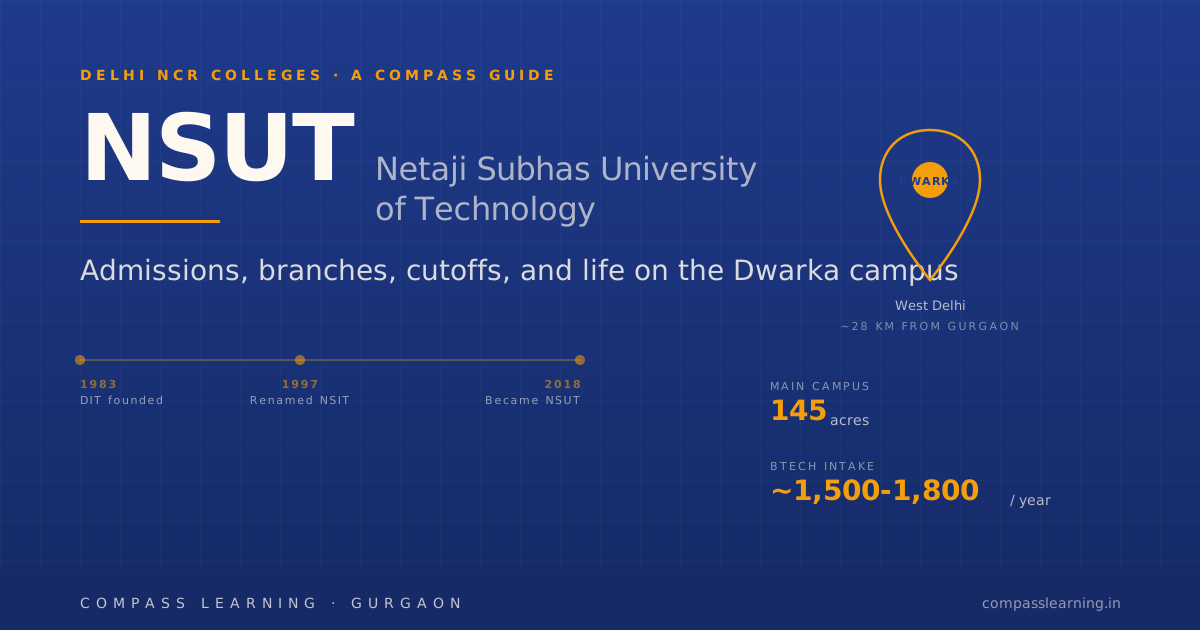
- 1983: Founded as Delhi Institute of Technology (DIT)
- 1997: Renamed Netaji Subhas Institute of Technology (NSIT)
- 2018: Transitioned to state university status as Netaji Subhas University of Technology (NSUT)
The institute is funded by the Government of Delhi. The main campus sits at Dwarka Sector 3, in west Delhi. A newer West Campus at Jaffarpur Kalan has been added more recently to expand capacity.
A few things to understand structurally:
- It is large. BTech intake is around 1,500-1,800 students per year across all branches — comparable to DTU.
- It is engineering-focused. Unlike IPU, which is an umbrella university with many disciplines, NSUT is essentially an engineering institute that became a university. The cohort culture is concentrated.
- The main campus is established. The Dwarka campus has been operating since the late 1990s, with mature infrastructure and a well-developed culture. The West Campus is newer and still building up.
- The alumni network is substantial. Forty-plus years of graduates (under DIT, NSIT, and NSUT names) means a strong, well-distributed alumni base across Indian and global industry.
How admissions work
NSUT follows the same admissions framework as DTU and IIIT Delhi:
- Entrance exam: JEE Main only. JEE Advanced is not required.
- Counselling: Admissions happen through JoSAA, the central counselling system. For the end-to-end JoSAA process, see JoSAA Counselling Explained.
- Eligibility: Class XII with Physics, Chemistry, and Mathematics — typically 60% aggregate or higher for general category.
- Domicile reservation: 85% of seats are reserved for Delhi domicile candidates; 15% are open to all-India candidates outside Delhi.
The 85:15 ratio mirrors DTU's structure. If you are from Gurgaon (Haryana) without Delhi domicile status, you compete for only 15% of the seats — and outside-Delhi cutoffs are correspondingly tighter than the headline numbers might suggest.
There are also separate quotas (Delhi government employees' children, sports quota, and others) which are small but worth checking if any apply.
Branches and programs
NSUT offers BTech across a broad range, with several recently added emerging-field options:
- Computer Science and Engineering (COE) — the flagship branch
- Information Technology (IT)
- Computer Science with specialisations in AI, Cybersecurity, Data Science, and others (recently added; specific list shifts year to year)
- Electronics and Communication Engineering (ECE)
- Electrical Engineering (EE)
- Instrumentation and Control Engineering (ICE)
- Mathematics and Computing (MAC)
- Mechanical Engineering with Automation (MAE)
- Manufacturing Process and Automation Engineering (MPAE)
- Biotechnology (BT)
The COE-AI and similar specialisation branches added in recent years have proven popular and competitive. If you want a CS-leaning seat at NSUT but the headline COE cutoff is out of reach, the specialisation branches can be a reasonable alternative — but verify the placement record for each one before committing, since some are newer and don't yet have a long placement history.
Cutoffs and competitiveness
Cutoffs vary by branch, domicile (Delhi vs outside-Delhi), and category. Rough patterns from recent years:
- COE, outside-Delhi general: typically closes around AIR 4500-6500
- IT / COE-AI / MAC, outside-Delhi general: typically AIR 6000-9000
- ECE, outside-Delhi general: typically AIR 11000-15000
- EE / ICE, outside-Delhi general: typically AIR 18000-25000
- Mechanical / MPAE / Biotech, outside-Delhi general: typically AIR 25000-40000+
- COE, Delhi domicile general: typically AIR 7500-10000
- Reserved category cutoffs are higher; specific cutoffs for West Campus are typically lower than main campus
These numbers shift each year and should be used as orientation rather than targets. For accurate planning, look up the latest JoSAA closing-rank data.
Campus, hostel, and student life
The Dwarka main campus is around 145 acres, smaller than DTU's Bawana campus but comfortably sized. The West Campus at Jaffarpur Kalan is newer and adds capacity for newer branches.
- Hostels: Multiple hostel blocks at the main campus. First-year hostel allocation is generally available for outside-Delhi students. Some Delhi-domicile students also opt for hostels.
- Sports infrastructure: Cricket and football grounds, courts, gym facilities. Sports culture is active.
- Libraries and labs: Central library plus department-specific labs. Infrastructure is well-established at the main campus.
- Clubs and societies: Wide range — technical clubs (robotics, coding, electronics), entrepreneurship cells, cultural societies, music and drama groups.
- Annual fests: Innovision (technical) and Moksha (cultural) are major events drawing participants from across NCR colleges.
The main campus is more compact than DTU's, which gives it a slightly tighter community feel. Students who want a substantial campus experience with hostels and active student life will find NSUT delivers that.
Placements
NSUT's placement statistics are comparable to DTU's and reflect a similar pattern — strong CS/IT outcomes, decent ECE, moderate core branches:
- Overall average package: typically ₹12-15 LPA across branches
- COE / IT / COE-AI: typically ₹20-25 LPA average, with the top of the distribution well above ₹40 LPA
- ECE: typically ₹12-16 LPA average
- Core branches (EE, ICE, MAE, MPAE): typically ₹8-12 LPA average
- Highest package: ₹1+ crore in top years
- Top recruiters: Microsoft, Google, Goldman Sachs, Adobe, Amazon, JP Morgan, McKinsey, major banks, and a long tail of Indian and multinational companies
The placement distribution is bimodal in a familiar way: top CS branches deliver strong outcomes; core branches deliver respectable but considerably lower averages. As with DTU, treat NSUT as a collection of branch-specific career outcomes rather than a single institute-level result.
Fees and financial aid
NSUT's fee structure is in the moderate state-university range:
- Tuition + academic charges: ~₹1.5-2 lakh per year
- Hostel + mess: additional ~₹70,000-1 lakh per year
- Four-year total: typically in the ₹8-12 lakh range, including hostel
This makes NSUT (like DTU) significantly more affordable than IIIT Delhi or private universities, while delivering placement outcomes that are competitive with both for the top branches.
Scholarships are available:
- Merit-based for top scorers
- Need-based for economically weaker sections
- Delhi state government schemes for domicile students
- External scholarships
If you qualify, apply during the first semester rather than waiting.
For Gurgaon students specifically
NSUT's Dwarka location makes it noticeably more accessible from Gurgaon than DTU's Bawana campus:
Commute:
- By Metro: Gurgaon (Sikanderpur / MG Road / Huda) → Yellow Line to Rajiv Chowk → Blue Line towards Dwarka → ~60-80 minutes total. The Dwarka stations are reasonably close to campus.
- By car or cab: ~50-70 minutes via Dwarka Expressway or NH-48, depending on traffic
- Reality check: Daily commute is workable for highly motivated students, but most outside-Delhi students opt for hostel. The time saved over four years is substantial.
Hostel allocation: Outside-Delhi students typically get hostel allocation. Delhi-domicile students from Gurgaon (note: Gurgaon is Haryana, not Delhi domicile) compete in the general all-India pool but can typically get hostels. Confirm during your admission round.
Alumni in Gurgaon: NSIT/NSUT alumni are strongly represented in Gurgaon's tech industry — at Microsoft (Sector 18), Adobe, Google's Gurgaon offices, and across the unicorn cluster in Cybercity, Udyog Vihar, and Sohna Road. The network is large and active; reaching out to a senior alumnus for a coffee chat is generally easy.
What to know before committing
A few items on the record worth considering:
- The 2018 transition from NSIT to NSUT created some administrative noise. Older alumni still refer to themselves as "NSIT" graduates, and recruiters generally treat NSIT and NSUT as the same institution. But some processes — degree formats, certain affiliations — were in transition for a few years after the change.
- The West Campus is newer. If you are admitted to West Campus rather than the main Dwarka campus, the infrastructure, hostel availability, and student culture are still developing. This isn't necessarily a problem, but it's a different experience from main campus and worth understanding before accepting.
- Branch outcomes vary. As with DTU, the COE average and the Biotech average are meaningfully different career starts. Choose branch deliberately, not just to "get into NSUT."
- Class sizes are large. With 1,500+ students per year, individual faculty attention depends on your initiative. Smaller environments like IIIT Delhi can offer more personalised research engagement.
Is NSUT the right fit?
The university is a strong fit if:
- You want a traditional engineering university experience with hostels, large campus, and broad branch options
- You are targeting one of the strong branches (COE, IT, COE-AI variants, MAC, ECE) and can compete at the corresponding cutoff
- You value Delhi NCR proximity and the active alumni network in Gurgaon-area industry
- The moderate fee structure works for your family
- You are comfortable in a large cohort and proactive about engagement
The fit is less clear if:
- You strongly prefer a small, research-intensive environment (IIIT Delhi may be a better match)
- You are uncertain about your branch and might land in a less-placing one — the wrong branch at NSUT can meaningfully affect career start
- You have specific concerns about West Campus and the main campus seat is out of reach
For students choosing between NSUT and DTU at the top branches — say, NSUT COE vs DTU Computer Engineering — both institutes are genuinely comparable in placement outcomes. The deciding factors tend to be location (Dwarka vs Bawana), specific branch preferences, and the campus feel you prefer. There is no objectively "better" choice between them at the top.
If you're thinking through engineering admissions and want to talk it through, we're at Ardee City, Sector 52, Gurgaon. Drop by anytime — a fifteen-minute conversation is usually enough to start clarifying which direction makes sense for you.
For more on how admissions, counselling, and college choice fit together, see our full Engineering Admissions Roadmap.