DTU (Delhi Technological University): Admissions, Branches, Cutoffs, and Life on the Bawana Campus
A college with eight decades of history
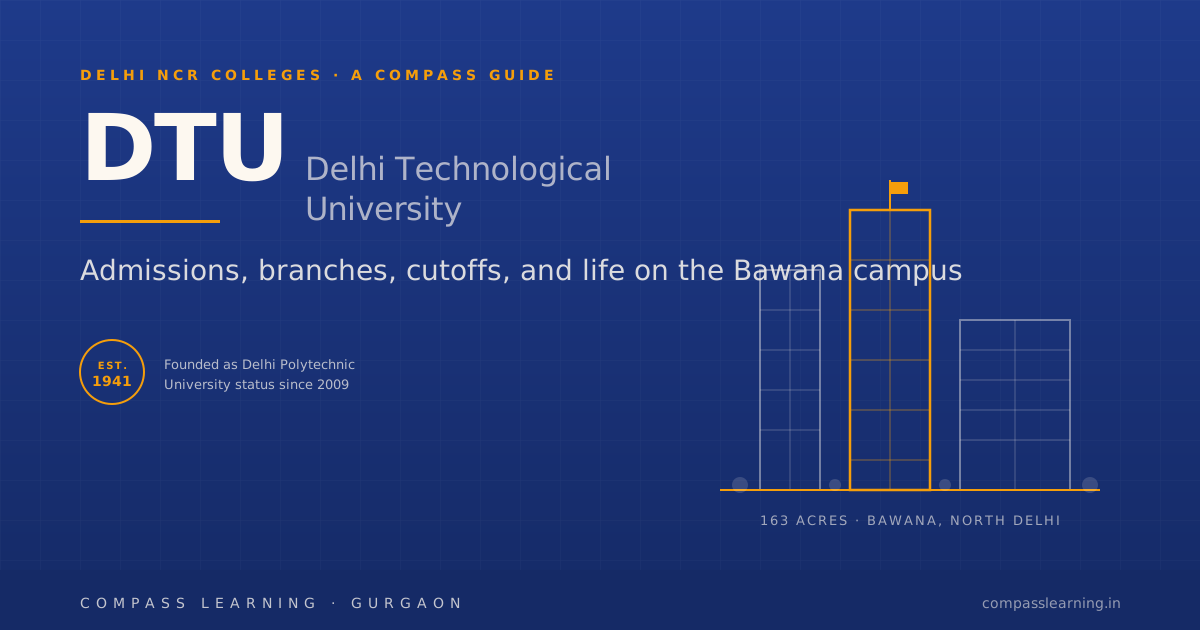
DTU is one of the oldest engineering institutions in India. It started in 1941 as the Delhi Polytechnic, became Delhi College of Engineering (DCE) in 1965, and transitioned to its current status as a state university — Delhi Technological University — in 2009. For most of its history, DCE was considered the strongest engineering college in Delhi outside the IITs, and its alumni network still reflects that legacy.
The campus today sits at Bawana Road in Rohini, north-west Delhi — a substantial distance from Gurgaon. The institute is large, traditional in feel, and offers an unusually broad range of engineering branches. This article walks through what DTU is, how admissions work, what you can study there, and how to think about whether it fits your situation.
Note: This article is written to be evergreen, but specific dates, fees, eligibility thresholds, and cutoff numbers are set each year by the institute, JoSAA, and the Government of Delhi. Always cross-check the latest official notifications before acting on anything time-sensitive.
About the university
A few things to understand about how DTU is structured:
- It is a state university, not a central institution. It is funded primarily by the Government of Delhi and reports to the Delhi state government.
- It is large. BTech intake is around 1,300 students per year across many branches, which is roughly five times the size of IIIT Delhi.
- It offers a broad range of branches. Unlike IIIT Delhi's almost-entirely-computing focus, DTU has the full traditional engineering spectrum — mechanical, civil, electrical, chemical, biotech — plus computer science, software engineering, and several emerging fields.
- The alumni network is substantial. Eighty-plus years of graduating engineers means DCE/DTU alumni are present at senior levels across Indian industry, the Indian Administrative and Engineering Services, and increasingly at major global technology companies.
The campus is around 163 acres — large by any standard, much larger than IIIT Delhi's compact 25 acres. There is room for hostels, sports infrastructure, multiple academic blocks, and outdoor spaces in a way that gives DTU a more traditional university feel.
How admissions work
DTU follows essentially the same admissions framework as other Delhi state universities:
- Entrance exam: JEE Main only. JEE Advanced is not required.
- Counselling: Admissions happen through JoSAA, the central counselling system. (For the end-to-end JoSAA process, see JoSAA Counselling Explained.)
- Eligibility: Class XII with Physics, Chemistry, and Mathematics — typically 60% aggregate or higher for general category.
- Domicile reservation: 85% of seats are reserved for Delhi domicile candidates; 15% are open to all-India candidates outside Delhi.
The 85:15 ratio is important. If you are from Gurgaon (Haryana) and don't have Delhi domicile status, you are competing for only 15% of the seats. That makes the outside-Delhi cutoffs significantly tighter than the headline numbers you may see for the institute.
There are also separate quotas for sons and daughters of Delhi government employees, sports quota, and similar — these are small but worth checking if any apply to you.
Branches and programs
DTU offers BTech across the traditional engineering disciplines and several newer ones. The current branches include:
- Computer Engineering (COE) — the most sought-after branch
- Software Engineering (SE)
- Information Technology (IT)
- Mathematics and Computing Engineering (MCE) — a CS-heavy programme with a strong math foundation
- Electronics and Communication Engineering (ECE)
- Electrical Engineering (EE)
- Mechanical Engineering (ME)
- Production and Industrial Engineering (PIE)
- Civil Engineering (CE)
- Environmental Engineering (ENE)
- Chemical Engineering (CHE)
- Polymer Science and Chemical Technology (PSCT)
- Engineering Physics (EP)
- Biotechnology (BT)
There is real variation in employment outcomes across these branches, and that variation is important to understand before you make your preference list. Computer Engineering, Software Engineering, IT, MCE, and ECE place at significantly higher averages than the core branches like Civil, Production, or Biotechnology. If you are unsure about your branch, talk to current students or recent alumni in each one before committing.
Cutoffs and competitiveness
Cutoffs depend on branch, domicile (Delhi vs outside-Delhi), and category. Rough patterns from recent years:
- Computer Engineering, outside-Delhi general: closes around AIR 4000-6500
- Software Engineering, outside-Delhi general: closes around AIR 5000-7500
- IT / MCE, outside-Delhi general: closes around AIR 7000-10000
- ECE, outside-Delhi general: closes around AIR 12000-15000
- Mechanical / EE, outside-Delhi general: closes around AIR 18000-25000
- Civil / Production / Biotech, outside-Delhi general: typically AIR 30000-50000
- Computer Engineering, Delhi domicile general: closes around AIR 7000-9500
- Reserved category cutoffs are correspondingly higher
These ranges shift each year. They give you a sense of the competitive landscape but should not be used as final targets. Always look up the latest JoSAA closing-rank data for the most accurate read.
Campus, hostel, and student life
DTU has the campus profile of an established engineering university:
- Hostels: Multiple hostel blocks for boys and girls, with mess facilities. First-year hostel allocation is generally guaranteed for outside-Delhi students; Delhi domicile students sometimes get hostels too, depending on availability.
- Sports infrastructure: Cricket and football grounds, basketball and tennis courts, swimming pool, athletic facilities. Sports culture is active.
- Library and labs: Large central library; well-equipped labs across departments. Some facilities are newer; others reflect the older heritage of the campus.
- Clubs and societies: Wide range — technical, entrepreneurship, cultural, literary, music, drama. The size of the institute means almost any interest has a corresponding club.
- Annual fests: Engifest (cultural) and Innovision (technical) are flagship events drawing participants from across NCR colleges and beyond.
The hostel life and large campus give DTU a more traditional engineering-college experience than IIIT Delhi or some of the newer private universities. Students who want immersive residential life, lots of campus events, and a peer culture built around hostel friendships tend to fit in well here.
Placements
Placement statistics at DTU are strong, especially for the CS-leaning branches:
- Overall average package: typically ₹12-15 LPA across all branches
- Computer Engineering / Software Engineering: typically ₹22-30 LPA average, with median around ₹20 LPA
- IT / MCE: typically ₹18-22 LPA average
- ECE: typically ₹12-16 LPA average
- Core branches (Mech, Civil, Production): typically ₹8-12 LPA average
- Highest package: ₹1+ crore in top years (international or specialised offers)
- Top recruiters: Microsoft, Google, Goldman Sachs, Adobe, Amazon, JP Morgan, McKinsey, several major banks, plus a long tail of Indian and multinational companies
A note on the averages: because DTU is large, the average can mask significant variation between branches. The Computer Engineering numbers look excellent; the Civil and Production numbers are healthy but considerably lower. If placement is a key factor in your decision, look at branch-specific data, not the overall institute average.
Fees and financial aid
DTU's fee structure is significantly more moderate than IIIT Delhi or private universities:
- Tuition + academic charges: ~₹1.5-2 lakh per year
- Hostel + mess: additional ~₹70,000-1 lakh per year (varies by hostel)
- Four-year total: typically in the ₹8-12 lakh range, including hostel
For a family weighing engineering education costs, DTU sits in a comfortable mid-range — much more affordable than IIT Delhi or IIIT Delhi, while delivering placement outcomes that are competitive with both for the top branches.
Scholarships:
- Merit scholarships for top scorers
- Need-based aid for economically weaker sections
- Delhi state government schemes for domicile students
- Various external scholarships
The institute has historically had occasional debates about fee revisions, including student-led discussions when increases were proposed. The structure has generally remained more affordable than peer institutes — but verify the current numbers before committing.
For Gurgaon students specifically
DTU's location in Bawana Road, north-west Delhi, is a real factor for Gurgaon students. The distance is significantly greater than to IIIT Delhi:
Commute:
- By Metro: Gurgaon → Rajiv Chowk → switch to Yellow Line to Rithala, then auto or campus shuttle. Total ~120-150 minutes one way.
- By car or cab: ~90-110 minutes via Outer Ring Road and Bawana Road, depending heavily on traffic
- Reality check: Daily commute from Gurgaon to DTU is not really viable. The time and energy cost makes it impractical for an engineering workload. Hostel is the standard, expected choice for outside-Delhi students.
Hostel as the assumed mode: Plan for hostel from day one. This actually changes the experience meaningfully — DTU is a hostel-driven institute in a way that some of the newer Delhi colleges aren't. Late-night study sessions, mess politics, hostel cultural events, friendships formed in the corridors — these are central to the DTU experience.
Alumni in Gurgaon: DTU's alumni footprint in Gurgaon's industry is huge. Walk into Microsoft's Sector 18 office, Adobe Noida, the major banking and consulting firms at Cyber Hub, or the startup clusters on Sohna Road, and you will find DCE/DTU alumni at every level. For internships, referrals, and career conversations, the network is enormous and easy to tap.
What to know before committing
A few things on the record that you should weigh:
- Class sizes are large. With ~1,300 students per year and large branch cohorts, you won't get the individual attention that a smaller institute like IIIT Delhi can offer. Faculty interaction depends substantially on how proactive you are.
- Branch outcomes vary widely. A Computer Engineering seat is genuinely different from a Polymer Science seat in terms of career trajectory and placement statistics. Don't assume "DTU" is monolithic.
- Infrastructure varies by building. Some academic blocks and hostels are well-maintained and modern; others show their age. If you can visit before committing, do — talk to current students about which blocks they live and study in.
- The institute has been involved in administrative debates at various points — accreditation discussions, fee revision protests, structural questions about state-versus-central status. None of these have materially affected academic outcomes, but they are part of the background you should know about.
Is DTU the right fit?
The university is a strong fit if:
- You want a traditional engineering university experience with hostel life, large campus, and broad branch options
- You are targeting one of the strong branches (Computer Engineering, Software Engineering, IT, MCE, ECE) and can compete at the corresponding cutoff
- The moderate fee structure aligns with your family's budget for higher education
- You value a deep, established alumni network in Delhi NCR industry
- You are comfortable being one student among many — proactive about engaging with faculty and opportunities
The fit is less clear if:
- You strongly prefer a small, research-intensive academic environment (in which case IIIT Delhi may be a better match)
- You are uncertain about your branch and might land in a less-placing one — at DTU, the wrong branch can meaningfully affect your career start
- Your living situation makes Bawana-based hostel life impractical (rare but worth thinking through)
For students choosing between DTU Computer Engineering and an IIT branch in a non-computing field — say, IIT Roorkee Civil or IIT Bombay Metallurgy — the question becomes whether the IIT brand and broader engineering exposure matter more, or whether DTU's strong CS placement and Delhi NCR alumni network are a more direct path to where you want to go. This is a real, common choice for students in the JoSAA top 5,000-10,000 range, and there is no single right answer.
If you're thinking through engineering admissions and want to talk it through, we're at Ardee City, Sector 52, Gurgaon. Drop by anytime — a fifteen-minute conversation is usually enough to start clarifying which direction makes sense for you.
For more on how admissions, counselling, and college choice fit together, see our full Engineering Admissions Roadmap.