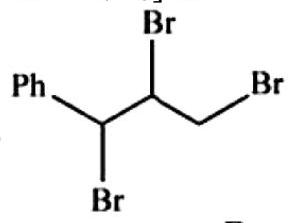
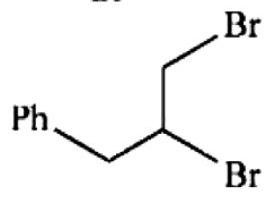
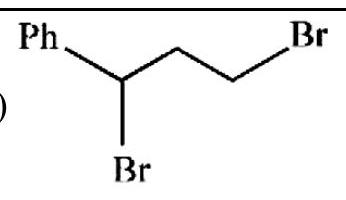
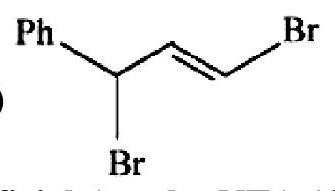
The substrate here is cinnamyl bromide, Ph−CH=CH−CHX2Br, and the reagent is HBr, so this is an electrophilic addition of the acid across the carbon-carbon double bond; the pre-existing primary C−Br bond is a spectator and is not touched. Protonation of the alkene could in principle happen at either sp2 carbon, and the pathway that operates is the one that generates the more stable carbocation, because that intermediate forms fastest and dictates the major product. If the proton adds to the carbon that already carries the CHX2Br group, the positive charge is left on the benzylic carbon next to the ring, giving Ph−C+H−CHX2−CHX2Br; this benzylic cation is resonance-stabilised by delocalisation into the phenyl ring, whereas protonating the other way would place the charge on an ordinary secondary carbon with no such help. Following Markovnikov's rule, the hydrogen therefore adds so as to build the benzylic carbocation, and the bromide ion set free in that first step then attacks the benzylic carbon. A bromine is thus installed on the benzylic position while the original bromine on the far carbon is retained, and the major product is Ph−CHBr−CHX2−CHX2Br, that is 1,3-dibromo-1-phenylpropane with the two bromine atoms held three carbons apart.
JEE Main · 2022 · 28 Jun 2022 · Shift 1 · Single correct option