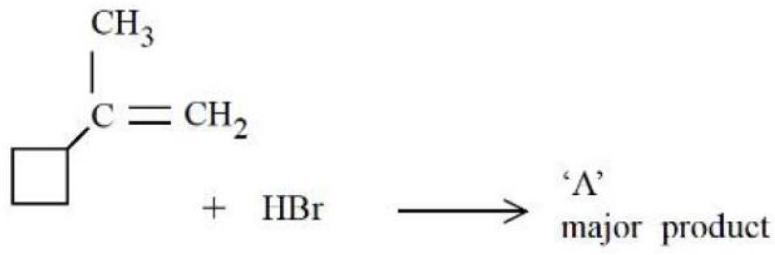
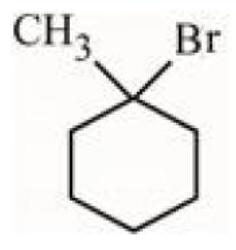
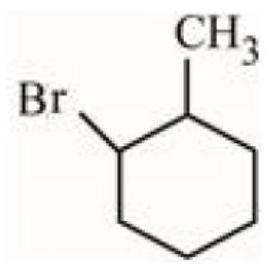
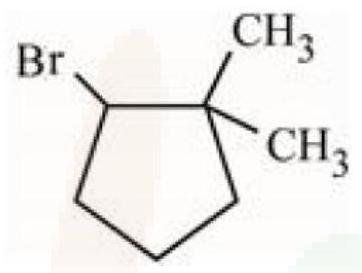
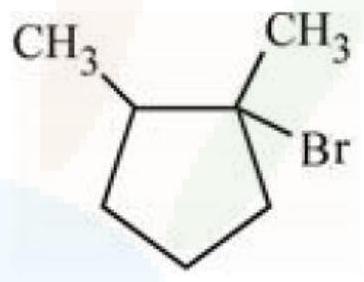
Isopropenylcyclobutane adds hydrogen bromide by Markovnikov's rule: the proton attaches to the terminal =CH2 and the positive charge settles on the carbon bearing the methyl group and the ring, a tertiary cation adjacent to a strained four-membered ring. A ring carbon–carbon bond migrates to this centre, expanding the cyclobutane into a less strained cyclopentane ring and shifting the charge onto a ring carbon. A methyl group then migrates to place the charge on the carbon holding the remaining methyls, giving the more stable tertiary ring cation, which bromide captures. The major product is 1-bromo-1,2-dimethylcyclopentane.
JEE Main · 2023 · 24 Jan 2023 · Shift 1 · Single correct option