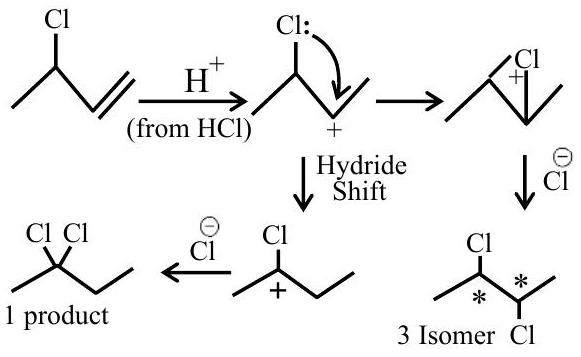
The number of possible isomeric products formed when 3-chloro-1-butene reacts with HCl through carbocation formation is ______
Answer: 4
Solution
Protonation of the terminal double bond of CH2=CH−CHCl−CH3 places the charge on the secondary carbon, giving CH3−C+H−CHCl−CH3. Capture of chloride here yields 2,3-dichlorobutane, which has two equivalent stereocentres and so exists as a d, an l and a meso form, that is three stereoisomers. The same cation can undergo a hydride shift onto the chlorine-bearing carbon, where the charge is stabilised by a chlorine lone pair; chloride capture there gives 2,2-dichlorobutane as one further product. Altogether the number of isomeric products is four.