JEE Main · 2026 · 22 Jan 2026 · Shift 2 · Haloalkanes and Haloarenes

WhatsApp Email
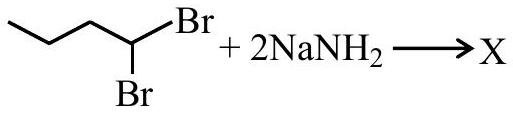
Consider the following reaction :


The product Y formed is :
  1. (A)2-methylhex-2-yne
  2. (B)5-methylhex-2-yne
  3. (C)2-methylhex-3-yne✓ Correct
  4. (D)Isopropylbut-1-yne

Answer: (C)

Solution

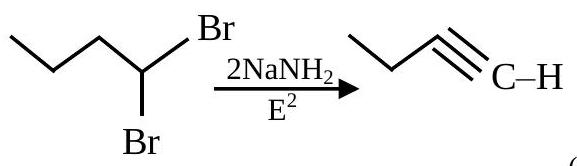
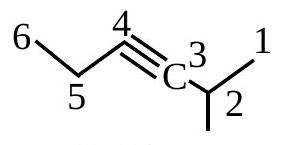
Double dehydrohalogenation of -dibromobutane by two equivalents of sodamide gives but--yne, whose terminal hydrogen is then removed by the excess base to form the acetylide. This acetylide displaces bromide from isopropyl bromide in an step, attaching an isopropyl group to the terminal carbon to give . Numbering the six-carbon chain places the methyl at C-2 and the triple bond between C-3 and C-4, so the product Y is 2-methylhex-3-yne.

JEE Main · 2026 · 22 Jan 2026 · Shift 2 · Single correct option
More JEE Main questions on Haloalkanes and Haloarenes

  1. The correct order of reactivity of in methanol with the following nucleophiles is and
    JEE Main 2026View solution →
  2. The correct order of the rate of reaction of the following reactants with nucleophile by mechanism is :
    (Given : Structure I and II are rigid)
    JEE Main 2026View solution →
  3. The correct order of reactivity of the following benzyl halides towards reaction with KCN is:
    JEE Main 2026View solution →
  4. The correct order of the rate of the reaction for the following reaction with respect to nucleophiles is:
    JEE Main 2026View solution →
  5. Given below are four compounds:
    (a) n-propyl chloride
    (b) iso-propyl chloride
    (c) sec-butyl chloride
    (d) neo-pentyl chloride

    Percentage of carbon in the one which exhibits optical isomerism is:
    JEE Main 2026View solution →
  6. The correct sequence of reagents for the above conversion of X to Y is :
    JEE Main 2026View solution →