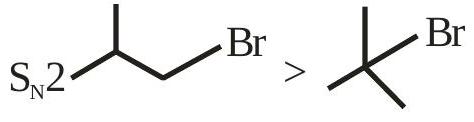
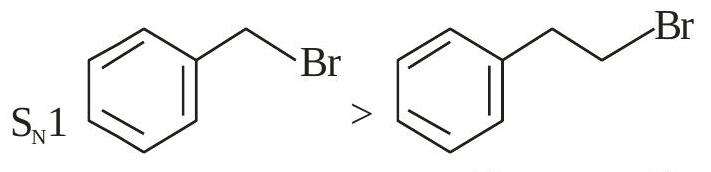
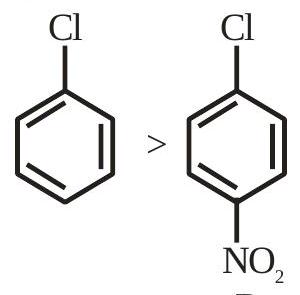
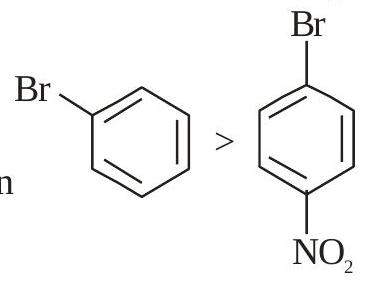
Identify the correct order of reactivity for the following pairs towards the respective mechanism (A) (B) (C) Electrophilic substitution (D) Nucleophilic substitution
Choose the correct answer from the options given below :ABCD
(A)(A), (B) and (D) only
(B)(A), (B), (C) and (D)✓ Correct
(C)(A), (C) and (D) only
(D)(B), (C) and (D) only
Answer: (B)
Solution
In the first pair, aimed at bimolecular substitution, the primary isobutyl bromide is attacked far more readily than the fully substituted tertiary tert-butyl bromide, whose crowded carbon blocks backside attack, so the primary halide is the more reactive. In the second pair, aimed at unimolecular substitution, benzyl bromide ionises to a resonance-stabilised benzylic cation whereas its homologue can give only an ordinary primary cation, so benzyl bromide is the faster. In electrophilic aromatic substitution a ring deactivated by a single chlorine is still richer in electrons than one bearing both a chlorine and a strongly withdrawing nitro group, so chlorobenzene reacts faster than its nitro derivative. In nucleophilic aromatic substitution a nitro group placed para to the leaving group stabilises the negatively charged intermediate, so the nitro-substituted aryl halide reacts faster than the plain one. Taken in their correct sense, all four orders are right.
JEE Main · 2023 · 10 Apr 2023 · Shift 1 · One or more correct options