JEE Main · 2023 · 06 Apr 2023 · Shift 1 · Haloalkanes and Haloarenes

WhatsApp Email
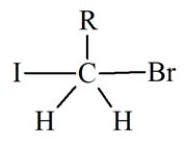
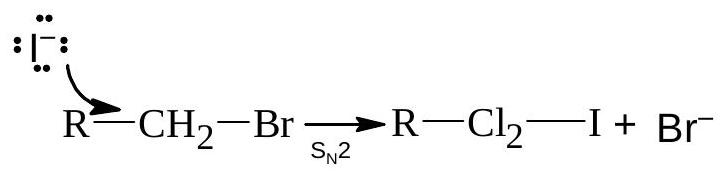
For the reaction:


The correct statement is:
  1. (A)The transition state formed in the above reaction is less polar than the localised anion.✓ Correct
  2. (B)The reaction can occur in acetic acid also.
  3. (C)The solvent used in the reaction solvates the ions formed in rate determining step.
  4. (D) can act as competing nucleophile.

Answer: (A)

Solution

This is a Finkelstein exchange, a bimolecular substitution carried out in acetone. In the transition state the negative charge is spread over both the incoming iodide and the departing bromide, so the charge is dispersed and the transition state is less polar than a fully localised halide anion. Acetone, an aprotic solvent, solvates anions poorly and so favours the nucleophile, while a protic medium such as acetic acid would solvate the anion and hinder the reaction; moreover sodium bromide precipitates from acetone, removing bromide so it cannot compete. The correct statement is that the transition state is less polar than the localised anion.

JEE Main · 2023 · 06 Apr 2023 · Shift 1 · Single correct option
More JEE Main questions on Haloalkanes and Haloarenes

  1. The correct order of reactivity of in methanol with the following nucleophiles is and
    JEE Main 2026View solution →
  2. The correct order of the rate of reaction of the following reactants with nucleophile by mechanism is :
    (Given : Structure I and II are rigid)
    JEE Main 2026View solution →
  3. The correct order of reactivity of the following benzyl halides towards reaction with KCN is:
    JEE Main 2026View solution →
  4. The correct order of the rate of the reaction for the following reaction with respect to nucleophiles is:
    JEE Main 2026View solution →
  5. Given below are four compounds:
    (a) n-propyl chloride
    (b) iso-propyl chloride
    (c) sec-butyl chloride
    (d) neo-pentyl chloride

    Percentage of carbon in the one which exhibits optical isomerism is:
    JEE Main 2026View solution →
  6. Consider the following reaction :


    The product Y formed is :
    JEE Main 2026View solution →