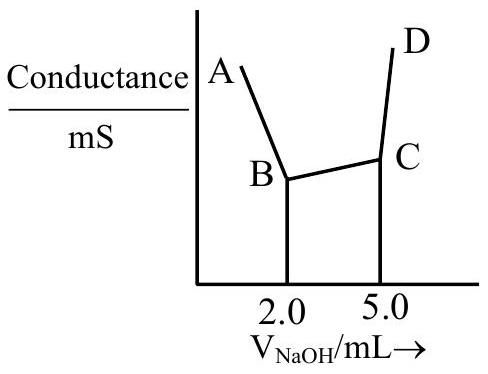
40 mL of a mixture of CH3COOH and HCl (aqueous solution) is titrated against 0.1 M NaOH solution conductometrically. Which of the following statement is correct?
(A)The concentration of CH3COOH in the original mixture is 0.005 M
(B)The concentration of HCl in the original mixture is 0.005 M✓ Correct
(C)CH3COOH is neutralised first followed by neutralisation of HCl
(D)Point 'C' indicates the complete neutralisation HCl
Answer: (B)
Solution
In the mixture the strong acid HCl is fully ionised while the weak acid CH3COOH is barely ionised, so added NaOH first neutralises HCl: the highly mobile H+ is replaced by Na+ and the conductance falls until 2.0mL has been added. From 2.0 to 5.0mL the acetic acid is converted to its salt, giving a gentle rise, and beyond 5.0mL the excess OH− makes it climb steeply. For HCl, the moles used are 0.1×2.0/1000=2×10−4mol in 40mL, so its concentration is 2×10⁻⁴/0.040=0.005M. The concentration of HCl in the original mixture is 0.005M.
JEE Main · 2025 · 03 Apr 2025 · Shift 2 · Single correct option