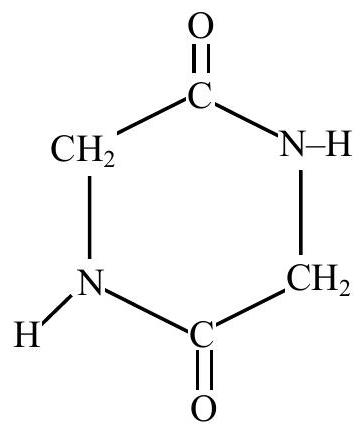
A dipeptide, "x" on complete hydrolysis gives "y" and "z". "y" on treatment with aq. HNO2 produces lactic acid. On the other hand "z" on heating gives the following cyclic molecule.
Based on the information given, the dipeptide X is:
(A)valine-glycine
(B)alanine-glycine✓ Correct
(C)valine-leucine
(D)alanine-alanine
Answer: (B)
Solution
Complete hydrolysis splits the dipeptide into two amino acids. The one that reacts with nitrous acid to give lactic acid, CH3CH(OH)COOH, must have begun as the matching α-amino acid CH3CH(NH2)COOH, which is alanine, since nitrous acid replaces the amino group by a hydroxyl. The other residue, on heating, forms the symmetric six-membered diketopiperazine carrying two CH2 groups and two N−H units, which is the cyclic anhydride of glycine, so that residue is glycine. The dipeptide is therefore alanine−glycine.
JEE Main · 2025 · 04 Apr 2025 · Shift 2 · Single correct option