JEE Main · 2025 · 02 Apr 2025 · Shift 1 · Chemical Thermodynamics

WhatsApp Email
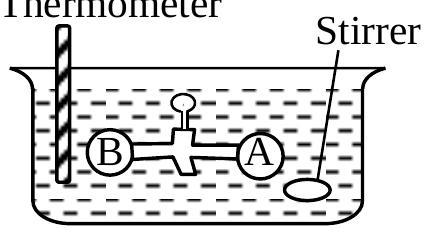
Two vessels A and B are connected via stopcock. The vessel A is filled with a gas at a certain pressure. The entire assembly is immersed in water and is allowed to come to thermal equilibrium with water. After opening the stopcock the gas from vessel A expands into vessel B and no change in temperature is observed in the thermometer. Which of the following statement is true?
  1. (A)
  2. (B)
  3. (C)
  4. (D)The pressure in the vessel B before opening the stopcock is zero.✓ Correct

Answer: (D)

Solution

No temperature change accompanies the expansion, and the internal energy of an ideal gas depends only on temperature, so . The gas expands into the second vessel against nothing, so the external pressure is zero and no work is done; with and the heat exchanged is also zero. Such a free expansion, yielding no work and no temperature change, is possible only if the second vessel was evacuated beforehand, so its pressure before the stopcock was opened must have been zero.

JEE Main · 2025 · 02 Apr 2025 · Shift 1 · Single correct option
More JEE Main questions on Chemical Thermodynamics

  1. Which of the following graphs between pressure 'P' versus volume 'V' represent the maximum work done?
    JEE Main 2026View solution →
  2. For the reaction, , graph is plotted as shown below. Identify correct statements.

    A. Standard free energy change for the reaction is .
    B. As in graph i …
    JEE Main 2026View solution →
  3. Use the following data:
    Substance
    | …
    JEE Main 2026View solution →
  4. Dissociation of a gas takes place according to the following chemical reactions. At equilibrium, the total pressure is 1 bar at 300 K.

    The standard Gibbs energy of formation of the involv …
    JEE Main 2026View solution →
  5. Consider the following data:
    (methane, g)
    Enthalpy of sublimation of graphite
    Dissociation enthalpy of …
    JEE Main 2026View solution →
  6. If the enthalpy of sublimation of Li is , enthalpy of dissociation of is , ionization enthalpy of Li is , electron gain enthalpy of F is , standard enthalpy o …
    JEE Main 2026View solution →