Total number of isomeric compounds (including stereoisomers) formed by monochlorination of 2-methylbutane is ____.
Answer: 6
Solution
2-Methylbutane, (CH3)2CHCH2CH3, has four kinds of hydrogen, giving four constitutionally different monochloro products, two of which create a new stereocentre.
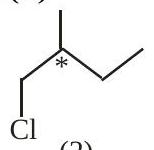
Substitution at either of the two equivalent methyl groups on C-2 gives 1-chloro-2-methylbutane, ClCH2CH(CH3)CH2CH3. C-2 now carries four different groups (CH2Cl, CH3, C2H5, H), so this product is chiral and exists as a pair of enantiomers — 2 isomers.
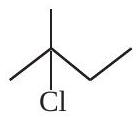
Substitution at the tertiary C–H gives 2-chloro-2-methylbutane, (CH3)2CClCH2CH3. This carbon bears two identical methyl groups, so it is achiral — 1 isomer.
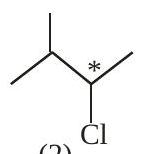
Substitution at the methylene group gives 2-chloro-3-methylbutane, CH3CHClCH(CH3)2. This carbon carries four different groups (Cl, H, CH3, CH(CH3)2), so it is chiral — 2 enantiomers.
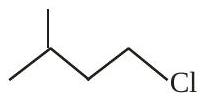
Substitution at the terminal methyl (C-4) gives 1-chloro-3-methylbutane, ClCH2CH2CH(CH3)2. No new stereocentre is created — 1 isomer.
Total number of isomeric monochloro products, counting stereoisomers: 2+1+2+1=6.Product 1Product 2Product 3Product 4
JEE Main · 2024 · 01 Feb 2024 · Shift 2 · Integer answer