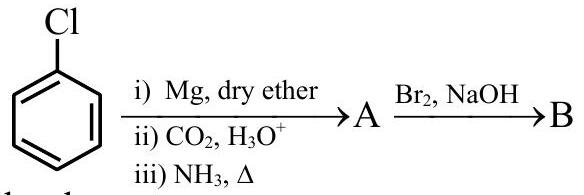
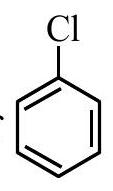
11.25 mg of chlorobenzene will produce ______ × 10⁻¹ mg of product B. (Consider the reactions result in complete conversion.) [Given molar mass of C, H, O, N and Cl as 12, 1, 16, 14 and 35.5 g mol⁻¹ respectively]
Answer: 93
Solution
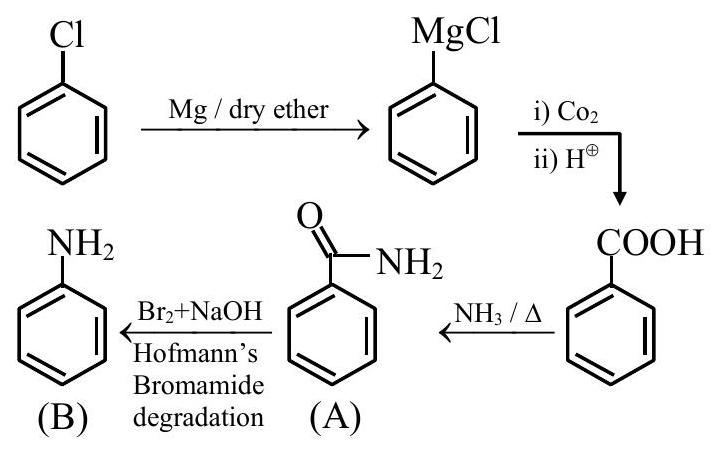
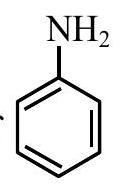
Chlorobenzene first forms phenylmagnesium chloride with Mg in dry ether; carbonation with CO2 followed by acidic workup gives benzoic acid, and heating benzoic acid with NH3 converts it to benzamide (A). Benzamide undergoes Hofmann bromamide degradation with Br2/NaOH: the carbonyl carbon is lost as carbonate/CO2 via isocyanate and carbamate intermediates, and the ring nitrogen ends up directly attached to the ring as aniline (B), one carbon fewer than the amide. The benzene ring is conserved throughout, so moles of chlorobenzene equal moles of aniline formed: 112.511.25×10−3=93x×10−1×10⁻³, giving x×10−1=93×0.1=9.3, so x=93.
JEE Main · 2025 · 28 Jan 2025 · Shift 1 · Integer answer