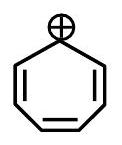
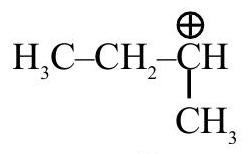
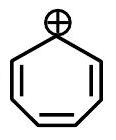
The correct order of stability of following carbocations is :CD
(A)A > B > C > D
(B)B > C > A > D
(C)C > B > A > D
(D)C > A > B > D✓ Correct
Answer: (D)
Solution
Cation C is a cyclic carbocation with its positive charge delocalised over a fully conjugated, planar ring — an aromatic six-π-electron system — and aromatic stabilisation outweighs ordinary resonance, making it the most stable of the four. Cation A, the triphenylmethyl (trityl) cation, spreads its positive charge over three phenyl rings by resonance and ranks next. Cation B, the diphenylmethyl cation, has only two phenyl rings to delocalise into, giving fewer resonance contributors than A and making it less stable than A. Cation D, a simple secondary alkyl cation, has neither an aromatic ring nor extended resonance and is stabilised only by hyperconjugation from adjacent C–H bonds, making it the least stable. Ranking aromaticity above resonance above hyperconjugation gives the stability order C>A>B>D.
JEE Main · 2025 · 28 Jan 2025 · Shift 1 · Single correct option