Let circle C be the image of x2+y2−2x+4y−4=0 in the line 2x−3y+5=0 and A be the point on C such that OA is parallel to x -axis and A lies on the right hand side of the centre O of C . If B(α,β), with β<4, lies on C such that the length of the arc AB is (1/6)th of the perimeter of C , then β−3α is equal to
(A)3
(B)3+3
(C)4−3
(D)4✓ Correct
Answer: (D)
Solution
The equation x2+y2−2x+4y−4=0 rewrites as (x−1)2+(y+2)2=9, a circle of centre (1,−2) and radius 3.
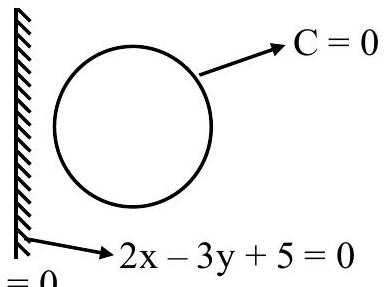
Reflecting the centre in the line 2x−3y+5=0: for a point (x1,y1) the image satisfies
2x−x1=−3y−y1=22+(−3)2−2(2x1−3y1+5).
With (x1,y1)=(1,−2), 2x1−3y1+5=2+6+5=13, so the factor is 13−2(13)=−2.
x=1+2(−2)=−3,y=−2+(−3)(−2)=4.
So circle C has centre O=(−3,4) and radius 3: (x+3)2+(y−4)2=9.
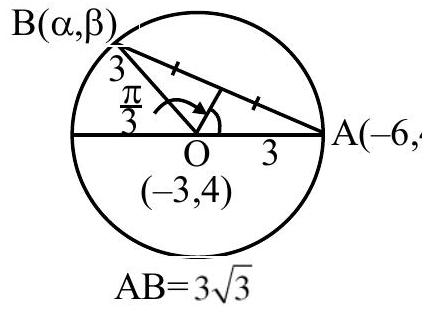
A lies on C with OA parallel to the x-axis on the right of O, so A=(0,4), corresponding to angular position θ=0 if points of C are written as (−3+3cosθ,4+3sinθ).
Arc AB is 61 of the perimeter, so the angle subtended at the centre is 61(2π)=3π. Since β<4, B lies below the horizontal through O, so θ=−3π: