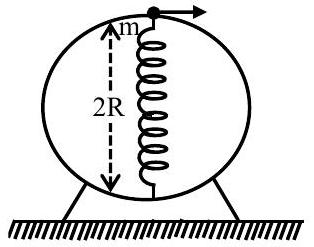
A bead of mass 'm' slides without friction on the wall of a vertical circular hoop of radius 'R' as shown in figure. The bead moves under the combined action of gravity and a massless spring (k) attached to the bottom of the hoop. The equilibrium length of the spring is 'R'. If the bead is released from top of the hoop with (negligible) zero initial speed, velocity of bead, when the length of spring becomes 'R', would be (spring constant is 'k', g is acceleration due to gravity)
(A)2gR+mkR2
(B)2Rg+m4kR2
(C)2Rg+mkR2
(D)3gR+mkR2✓ Correct
Answer: (D)
Solution
Place the center of the hoop at O and let P be the fixed point at the bottom where the spring is anchored, so OP = R. The bead starts at the point diametrically opposite P, i.e. at the top of the hoop, where the chord to P has length 2R. Since the spring's natural length is R, it starts stretched by an amount 2R - R = R.
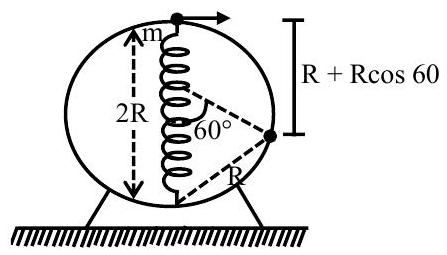
When the spring length becomes R again (natural length), the chord from the bead to P equals R. In the triangle formed by O, P and the bead, two sides (OP and O-bead) equal R, and now the third side (the chord) also equals R, so this is an equilateral triangle: the bead has swept through 60° as seen from O.
Taking O as origin with P at the bottom, the top of the hoop is at height R above O, while the bead's new position is at height Rcos60∘ below O, i.e. at −2R. So the bead has descended a total height
h=R−(−2R)=23R.
Applying the work-energy theorem to the bead (gravity does positive work as it falls, and the spring's stored elastic energy is released as it relaxes from extension R to zero):
mgh+21kR2=21mv2
mg⋅23R+21kR2=21mv2
v2=3gR+mkR2
v=3gR+mkR2
JEE Main · 2025 · 28 Jan 2025 · Shift 1 · Single correct option